
All eight functions assessed
All eight Jungian function-attitudes — Fe, Fi, Te, Ti, Ne, Ni, Se, and Si — are assessed separately, preserving patterns that letter-pair tests can flatten.

“A lens for seeing yourself more clearly.”
🧠 Discover your best-fit personality type.
See how you naturally think, work, and connect — through Jungian cognitive functions.
⏱️ Quick, practical, and free.
In 5 minutes, get insights for today’s AI-enabled world.
Privacy-first by design. Your test responses and results are processed locally in your browser and are not sent to our servers. If you choose to submit feedback, the information included in that feedback is transmitted. No account or direct personal identifiers are required. The site uses limited, cookieless usage analytics that are separate from your test responses.
Designed to explore cognition beneath behaviour. 16Selves assesses all eight Jungian function-attitudes separately through multi-faceted and contrasting self-report items.
Adaptive and hypothesis-based. Follow-up questions compare your strongest processes by how naturally, consistently, and effortlessly they arise. Results are presented as best-fit type hypotheses rather than definitive labels.
Interpret results reflectively. Like any self-report assessment, results can be influenced by self-perception, current circumstances, response style, and how you interpret the questions.
Full technical details. Read the 16Selves methodology paper (PDF). It describes the design rationale and scoring architecture. It is not an empirical validation study, and psychometric claims remain provisional.
Not a clinical or diagnostic tool. Results are intended for self-understanding, reflection, and personal growth and should not be used for medical, psychological, employment, educational, or other high-stakes decisions.
Trademark notice. MBTI® is a registered trademark of The Myers-Briggs Company. 16Selves® is independent and is not affiliated with or endorsed by The Myers-Briggs Company.
You can optionally rate your experience and share feedback below.
Many typology tests sort people by traits or letter pairs. 16Selves explores the cognitive processes behind how you notice, interpret, decide, and act.
All eight Jungian function-attitudes — Fe, Fi, Te, Ti, Ne, Ni, Se, and Si — are assessed separately, preserving patterns that letter-pair tests can flatten.
Questions explore what you notice, prioritise, and respond to, with optional examples that help distinguish similar processes.
Plausible alternatives, rather than obvious opposites, reduce agreement bias and sharpen distinctions between similar thinking styles.
Follow-up questions compare how naturally and consistently your strongest processes arise, helping separate preference from skill or circumstance.
16Selves presents several best-fit type hypotheses with relative fit estimates — a lens for reflection, not a box.
Responses are scored locally in your browser and stay on your device unless you share or export them. No account or personal identifiers are required.
Guides for interpreting your 16Selves results
These articles are designed for people who have just taken, or are about to take, a Jungian cognitive functions test. Start here if your results feel close, your type has changed across different tests, or you want to understand what the function scores mean in real life.
Read the article that matches your immediate question first, then compare the function explanations with your actual patterns over time. Your best-fit type should help you make better observations about yourself, not box you into a fixed identity.
When your results are close, that is not a failure of the test. It is useful information.
A good personality result should not pretend you are simpler than you are. When two possible types appear close together, it usually means your answers show a real overlap between neighbouring patterns. You may use one process naturally and another skilfully, or you may be answering from a current life context that is strengthening a less-preferred side of you.
Many test takers confuse what they can do with what they naturally return to. A person can be organised at work without leading with Te, emotionally supportive without leading with Fe, or imaginative without leading with Ne. The more useful question is not “Can I do this?” but “Which process feels like my home base when there is no external pressure?”
Four-letter type names are convenient, but cognitive functions explain why two similar-looking types can feel very different inside. INFJ and INFP, for example, differ not by one letter only but by entirely different dominant and auxiliary processes. INTJ and INTP may both seem analytical, yet one often narrows toward a strategic future while the other refines the internal logic of a model.
Your stress pattern can reveal more than your strengths. Under pressure, some people become rigid, procedural, and controlling. Others become scattered, restless, or unusually sensitive to rejection. If two type results are close, compare how each type tends to lose balance. The uncomfortable pattern is often more diagnostic than the flattering description.
The healthiest way to use a close result is to treat it as a shortlist. Read both type profiles, compare the first two functions of each, and notice which explanation predicts your real behaviour over time. Your best-fit type should clarify your recurring pattern, not simply compliment your identity.
These points turn a close result into a practical comparison: focus on underlying functions, distinguish natural preference from learned performance, and use recurring stress patterns as additional evidence.
The eight cognitive functions describe different ways of noticing, interpreting, deciding, and responding.
Cognitive functions are not talents, moods, or fixed behaviours. They are lenses. Each one describes a preferred way of directing attention and making meaning. Two people can behave similarly on the outside while using very different functions underneath. That is why cognitive-function typing often feels more precise than simple trait labels.
Perceiving functions describe how you take in information. Se notices what is happening now through direct contact with the world. Si compares the present to memory, precedent, and familiar patterns. Ne explores possibilities, alternatives, and unexpected connections. Ni follows underlying trajectories, symbolic meanings, and converging future patterns.
Judging functions describe how you evaluate and decide. Te organises action around measurable outcomes, external systems, and efficient execution. Ti refines internal logic, definitions, and consistency. Fe tracks relational atmosphere, shared values, and social impact. Fi protects inner alignment, personal meaning, and moral authenticity.
In function language, extraverted means oriented toward the outer world: shared systems, visible facts, interactive possibilities, or interpersonal atmosphere. Introverted means oriented toward inner reference points: memory, personal values, internal logic, or private pattern recognition. This is why a socially quiet person can still use an extraverted function strongly.
Your dominant and auxiliary functions usually describe the most reliable parts of your personality architecture. They shape what feels obvious, what you trust, and what kind of problem-solving feels natural. Lower functions are not bad; they are simply less conscious, less stable, and more likely to appear under stress or growth pressure.
This recap groups the eight functions by their core orientation, providing a compact reference for comparing how each process notices information or makes judgments.
Changing results can mean the test is weak, but it can also mean you are answering from different parts of yourself.
People often answer personality questions through the role they are currently living: manager, parent, student, founder, caregiver, partner, or exhausted problem-solver. A demanding job can make you report more Te. A relational crisis can make Fe or Fi more noticeable. A season of uncertainty can amplify Ne or Ni. The result reflects your answers, so your current context matters.
Many tests ask about surface behaviour: whether you plan, socialise, decide quickly, or enjoy novelty. Behaviour can shift with age, work, confidence, culture, and stress. Cognitive-function typing tries to go deeper by asking what kind of information you trust and what kind of judgement feels most natural. That pattern usually changes less than behaviour.
If you sit near the middle on a dimension, small changes in your answers can flip the final label. This is especially common when a test forces a single type without showing uncertainty. A probabilistic result is more honest: it shows which types are most likely and how close the alternatives are.
As people mature, they often develop functions that were previously neglected. An intuitive person may become more grounded. A feeling-oriented person may become more structured. A thinking-oriented person may become more relationally aware. That development can make you seem like a different type, but it may be your original pattern becoming more balanced.
Answer from repeated patterns, not ideals. Think about what you do when you are rested, unobserved, and not trying to impress anyone. Separate what you admire from what you naturally use. Then compare your result with descriptions of the full function stack, including stress and blind spots.
The main lesson is to interpret changing results through long-term patterns, context, and uncertainty rather than treating every new label as a complete change of personality.
INFJ and INFP can both seem idealistic, sensitive, and reflective, but they are built on different cognitive processes.
INFJ usually leads with Ni supported by Fe. INFP usually leads with Fi supported by Ne. That means the INFJ often begins with a private sense of pattern, implication, or future meaning, then translates it through relational awareness. The INFP often begins with inner value alignment, then explores possibilities that honour that inner truth.
INFJs tend to seek a unifying interpretation. They may ask, “What is really happening beneath the surface?” or “Where is this heading?” INFPs tend to seek authentic resonance. They may ask, “Is this true to what matters?” or “Does this violate something important inside me?” Both can be deep, but the centre of gravity differs.
Because INFJs use Fe, they often notice interpersonal atmosphere quickly and may feel responsible for managing it. They can soften themselves to preserve connection, even when they privately disagree. INFPs, using Fi, may be gentle but internally firm; they are often more distressed by self-betrayal than by surface disharmony.
INFPs with auxiliary Ne often generate multiple interpretations and alternative paths. They may enjoy keeping possibilities open while they test what feels meaningful. INFJs with dominant Ni often narrow toward one deep reading or symbolic through-line. They may not want endless options; they want the one that explains the pattern.
Under stress, INFJs may become overwhelmed by sensory details, immediate demands, or impulsive attempts to regain control of the present. INFPs may become unusually rigid, critical, or efficiency-focused, trying to force order through inferior Te. Stress does not define the type, but it often reveals the less-developed side of the stack.
The clearest distinction is the order of the first two functions: INFJs tend to organise experience around converging patterns and relational translation, while INFPs begin with inner values and explore aligned possibilities.
Your inferior function is not your enemy. It is the doorway to the part of life you often meet last.
In a Jungian stack, the inferior function is typically the least conscious of the main four functions. It often feels awkward, reactive, or strangely compelling. You may admire it in others, overdo it when anxious, or avoid it until life forces you to engage with it. Because it sits opposite the dominant function, it can feel like a threat and a missing piece at the same time.
When your usual strategy stops working, the psyche reaches for the opposite tool. A dominant intuitive type may be pulled into raw sensory overwhelm. A dominant sensing type may become lost in fearful predictions. A dominant thinking type may struggle with emotional vulnerability. A dominant feeling type may become blunt, rigid, or obsessed with efficiency.
Inferior Se may show up as impulsive sensory escape, over-focus on bodily discomfort, or feeling trapped by immediate demands. Inferior Si may show up as anxiety about details, health, precedent, or whether something has been done correctly. Inferior Ne may become catastrophic possibility-spinning. Inferior Ni may become ominous certainty about where things are heading.
Inferior Te may appear as harsh self-command, panic about productivity, or all-or-nothing plans. Inferior Ti may appear as over-analysis, detachment, or fear that one’s reasoning is incoherent. Inferior Fe may appear as sudden concern about rejection, reputation, or whether others approve. Inferior Fi may appear as confusion around personal values, emotional shutdown, or delayed recognition of what matters.
The goal is not to become your opposite type. The goal is to build a respectful relationship with the inferior function before crisis forces it into the room. Small, regular practice helps: grounding for inferior Se, routine for inferior Si, creative option-setting for inferior Ne, reflective pattern work for inferior Ni, practical planning for inferior Te, clean definitions for inferior Ti, honest relational repair for inferior Fe, and values clarification for inferior Fi.
These takeaways frame the inferior function as a useful stress signal and a gradual path for development, rather than as a flaw or a separate personality taking over.
A personality type should be a map, not a cage.
No type system can contain the full complexity of a person. Your type is not your destiny, your excuse, or your identity in total. It is a working model for recognising recurring patterns in attention, judgement, stress, and growth. The model is useful when it helps you observe yourself more accurately. It becomes harmful when it replaces observation with a label.
Instead of saying “I am this type, so I cannot do that,” ask, “Which part of this situation is stretching my less-developed functions?” A person with weak Te can still learn execution. A person with weak Fe can still learn social repair. A person with weak Se can still become grounded. Type explains friction; it should not forbid development.
Many people attach to a type because the description feels special, rare, intelligent, empathic, strategic, creative, or misunderstood. A better test is whether the type also explains your blind spots. The right pattern should feel clarifying, sometimes uncomfortable, and practical. If a type only flatters you, it may be functioning more like a fantasy than a mirror.
Typing can damage relationships when it becomes mind-reading. You may notice patterns, but people are still allowed to contradict your expectations. Use type language gently: as a way to understand communication needs, energy patterns, and decision styles, not as a way to dismiss someone’s experience.
The best use of type is iterative. Notice what energises you, what drains you, what kind of information you trust, what you avoid, and what happens under stress. Then adjust your understanding. Your type should help you become more responsible for your patterns, not more defended by them.
The practical aim is to use type as a flexible lens for observation and growth, while keeping real behaviour, personal responsibility, and individual complexity more important than the label.
Extraverted feeling (Fe) orients to the emotional tone and feelings of people around, tracking how everyone feels and adjusting to keep the social atmosphere harmonious as it shifts in real time.
People who lead with Fe notice when connection breaks and work to restore goodwill and harmony. They register the interpersonal mood before it is named and use it as a central cue for how to respond while shaping dynamics toward shared positivity.
At its best, Fe keeps interactions inclusive and emotionally coherent. It supports responsiveness, encouragement, and the ability to maintain relational warmth without losing the point.
At its most stretched, Fe may prioritize soothing emotions or restoring group warmth over solving the core problem, or avoid clear feedback that disrupts the emotional climate. Growth involves balancing harmony with directness and allowing some interpersonal dynamics to unfold on their own.
Introverted feeling (Fi) orients to personal values, noticing when something strongly aligns with or violates them and checking whether choices match deepest inner alignment.
People who lead with Fi change direction when a path no longer fits their core values even at personal cost. Their attention stays on whether actions feel congruent with inner moral sense rather than practical outcomes or group expectations.
At its best, Fi produces emotional honesty, moral steadiness, and deep respect for individual experience. It supports authenticity and the courage to act from personal significance.
At its most stretched, Fi may set aside practical requirements less readily or treat results others respect as secondary to perfect inner congruence. Growth involves bringing values into conversation and allowing external demands to inform without erasing inner alignment.
Extraverted thinking (Te) orients to practical results, noticing when efforts or systems produce or fail to produce desired outcomes and tracking missing resources or inefficient structures.
People who lead with Te push for clear goals, measurable outcomes, and decisive action rather than exploring ideas or focusing primarily on collaboration. They prefer enforcing structured plans over flexible adaptation to circumstances.
At its best, Te turns intention into execution through organization, clarification of expectations, and measurable progress.
At its most stretched, Te may undervalue open idea exploration or collaboration in favor of efficiency. Growth involves incorporating nuance, human context, and flexible responses alongside outcomes.
Introverted thinking (Ti) orients to logical coherence, noticing contradictions or logical gaps and tracking precise meanings and exact relationships.
People who lead with Ti identify fundamental principles that make a system coherent rather than caring primarily about usefulness or acceptance. They prefer elegant theoretical frameworks over purely practical solutions and address inconsistencies even when something mostly works.
At its best, Ti produces clarity, precision, and independent understanding through rigorous internal consistency.
At its most stretched, Ti may delay action while refining models or overlook practicality in favor of perfect logical fit. Growth involves allowing useful but imperfect explanations and incorporating feedback from real-world results.
Extraverted intuition (Ne) orients to hidden possibilities, noticing alternative interpretations and emerging opportunities while tracking connections between ideas as they arise.
People who lead with Ne play with multiple hypothetical scenarios rather than developing one solid idea or staying on a single clear track. They explore divergent options instead of converging on the most likely outcome.
At its best, Ne brings creativity, adaptability, and generative links across contexts.
At its most stretched, Ne may scatter energy by branching into too many possibilities instead of committing. Growth involves selecting paths so that possibilities can develop depth through follow-through.
Introverted intuition (Ni) orients to underlying patterns, noticing connections that form a coherent whole and tracking where current trends or insights are likely headed.
People who lead with Ni reorganize understanding and priorities around strong emergent insights rather than focusing on immediate demands or keeping all options open. They rely on flashes of insight over accumulated experience alone.
At its best, Ni brings foresight, synthesis, and strategic clarity from fragmented information.
At its most stretched, Ni may overlook immediate demands or treat sudden insights as more reliable than steady data. Growth involves testing patterns against current evidence and updating trajectories as new information arrives.
Extraverted sensing (Se) orients to immediate physical reality, taking in sights, sounds, and sensations while tracking moment-to-moment changes.
People who lead with Se instinctively adapt actions when conditions shift suddenly rather than sticking rigidly to plans. They register physical details readily instead of only when unavoidable and focus on tangible qualities over abstract meaning.
At its best, Se brings presence, responsiveness, and practical engagement with what is happening now.
At its most stretched, Se may act before considering longer-term effects or register physical details only when they become hard to ignore. Growth involves balancing immediate responsiveness with foresight and reflection.
Introverted sensing (Si) orients to familiar impressions, noticing when current experiences evoke memories or precedents and checking new situations against past reliable experience.
People who lead with Si adjust their approach based on what has reliably worked before rather than preferring new possibilities or experimenting with fresh approaches. They maintain focus on prior continuity over emerging patterns.
At its best, Si brings grounded judgement, careful attention, and experiential wisdom.
At its most stretched, Si may become overly tied to tried-and-true methods or filter the present too heavily through past impressions. Growth involves treating prior experience as guidance that new situations can revise.
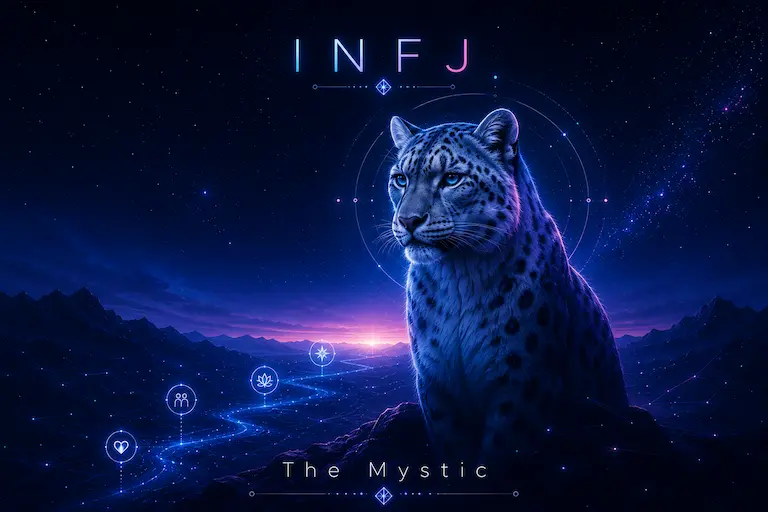
INFJs (Mystics) are pattern-converging integrators who automatically register emotional undercurrents and interpersonal needs (Fe), weaving those signals into a private forecast of where people and situations are likely headed (Ni). They move through life as quiet interpreters of coherence, always weighing spoken words against the unspoken emotional climate (Fe) and emerging trajectories (Ni).
They notice when disparate details suddenly link into one unified insight (Ni), often sensing shifts in trust, belonging, or group harmony (Fe) well before they become obvious. Because their forecasts (Ni) are filtered through an automatic sensitivity to emotional tone (Fe) and a drive to restore goodwill when connection breaks (Fe), they track how everyone feels and adjust to maintain shared positivity while staying anchored to inner congruence (Fi).
This pairing creates a layered inner map that feels almost predictive, though it stems from sustained attention to relational signals (Fe), value alignment (Fi), logical precision (Ti), and present-moment feedback (Se) rather than anything mystical. Over repeated cycles they refine this map (Ni), reorganising priorities around strong insights (Ni) and noticing contradictions or gaps (Ti) that threaten the emerging whole.
Common misconception: INFJs are not psychic; they automatically receive insights about patterns and trajectories (Ni) while long-term tuning into others’ feelings (Fe) lets them anticipate breaks in harmony and work to restore it with logical clarity (Ti).
Cultural archetype: The snow leopard reflects this type’s symbolic pattern: Rare, private, graceful, intense, and quietly powerful, the snow leopard gives INFJs mystique and moral seriousness without making them seem fragile. In popular typology discussions, figures sometimes associated with INFJ include Carl Jung, Mahatma Gandhi, and Fyodor Dostoevsky.
INFJs allow scattered emotional signals (Fe) and impressions to settle until they converge into one clear sense of direction and meaning (Ni).
Dominant introverted intuition (Ni) automatically surfaces insights about where current patterns are heading, while auxiliary extraverted feeling (Fe) tracks the group’s emotional atmosphere, notices when goodwill has fractured, and works to restore shared positivity. Tertiary introverted thinking (Ti) checks for logical contradictions and precise principles that keep the insight coherent.
They develop when they deliberately test these forecasts (Ni) against present-moment sensory feedback (Se) rather than letting the inner picture remain unexamined.
INFJs contribute most when roles combine long-range pattern reading (Ni) with attentive care for people (Fe) and ethical alignment (Fi).
They often excel in mentoring, strategic counsel, narrative design, education, advocacy, and healing work where both hidden trajectories (Ni) and human impact (Fe) matter. Their strength lies in weighing lasting consequences on trust and belonging (Fe) alongside immediate demands (Se).
They need protected focus time, genuine value congruence (Fi), and enough structure to move insight (Ni) into action without constant emotional labour (Fe) or vague direction.
INFJs achieve a state of flow when all four functions operate in tandem during activities such as writing a reflective article that synthesises subtle emotional patterns (Ni and Fe) while ensuring logical coherence (Ti) and incorporating real-world observations from a quiet walk (Se), or facilitating a meaningful group dialogue that anticipates relational shifts and adapts fluidly in the moment.
AI flourishing:
INFJs can use AI to surface and test private convergences (Ni): condensing disparate notes, modelling relational outcomes (Fe), drafting language for subtle insights, and turning forecasts (Ni) into forms others can examine and refine.
With mechanical synthesis reduced, their energy moves toward deeper presence: reflective mentoring, ethical design, community healing, and the patient work of helping people reconnect to meaning and goodwill (Fe) without being reduced to metrics.
The promise rests on keeping human discernment at the centre of purpose and care (Fi). Used poorly, AI could automate emotional restoration (Fe) or intensify invisible labour; used wisely, it returns time to lived relationships, moral clarity (Fi), and embodied communities that give insight (Ni) lasting value.
INFJs connect through depth, emotional safety (Fe), and attentive reading of whatever lies beneath the surface (Ni).
They automatically register tone, atmosphere, and unspoken needs (Fe), adjusting timing to preserve harmony and restore goodwill when it breaks. This makes them steady, perceptive companions, though they may quietly carry uninvited emotional weight (Fe).
They open gradually yet offer enduring loyalty once trust forms. Relationships thrive on reciprocal care and respectful engagement with their insights (Ni) rather than dismissal or idealisation.
Relational pattern:
In relationships they like to give quiet foresight (Ni), attuned emotional presence (Fe), loyal companionship that anticipates needs, and insightful reflections that help others feel deeply understood and supported in their growth.
They like to receive reciprocal depth, gentle questioning of their converging insights (Ni) without dismissal, space for their private inner world (Fi), and consistent emotional safety that allows them to lower their protective sensitivity (Fe) without fear of disruption.
They fear superficial connections that ignore underlying meaning, betrayal of trust that fractures harmony, and being overwhelmed by others’ emotions without reciprocity. They love relationships offering profound mutual understanding, gentle exploration of shared insights, and a safe space where vulnerability is met with loyalty and depth.
Mistyping notes:
INFJs are commonly mistaken for INFPs because both appear gentle, idealistic, and values-aware (Fi). INFJs converge observations into single trajectories (Ni) and emotional harmony (Fe), whereas INFPs begin with whether something aligns with personal values (Fi) and explore multiple hypothetical paths (Ne).
They may resemble ENFJs when socially engaged. ENFJs actively shape the emotional field (Fe) and restore group warmth in real time, while INFJs first withdraw to interpret converging patterns (Ni) before deciding how to respond.
With INTJs the shared Ni (introverted intuition) creates overlap in privacy and long-range thinking. INFJs filter forecasts through emotional climate (Fe), belonging, and value congruence (Fi), while INTJs organise around measurable efficiency (Te), logical gaps (Ti), and structural outcomes.
Shadow pattern:
Shadow functions refer to the four less conscious functions operating in the opposite attitude to the primary stack; they tend to emerge under stress, often as projection or disruptive behaviour, revealing aspects of the personality that have been neglected.
The anima (the unconscious feminine aspect in a man) or animus (the unconscious masculine aspect in a woman) is a Jungian archetype typically carried by the inferior function; it frequently appears in dreams, projections onto others, or moments of strong attraction, acting as a bridge to deeper unconscious material.
For INFJs, the shadow first appears through opposing extraverted intuition (Ne) that scatters focus into unfiltered possibilities and critical parent introverted feeling (Fi) that turns moralistically self-critical.
It can also appear through trickster extraverted thinking (Te) that produces blunt or chaotic demands for efficiency and demon introverted sensing (Si) that obsesses over negative past details or bodily discomfort.
Integrating the anima or animus through inferior extraverted sensing (Se) invites spontaneous presence and sensory engagement, transforming unconscious eruptions into greater wholeness, flexibility, and realistic grounding.
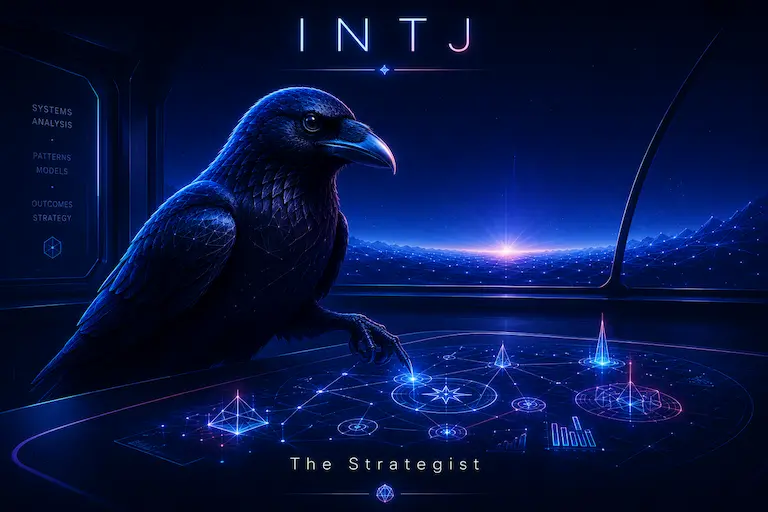
INTJs (Strategists) are trajectory-modelling architects who automatically detect long-range patterns and inefficiencies (Ni), translating those insights into clear goals, measurable outcomes (Te), and decisive structures. They treat the future as something that can be anticipated, engineered, and steadily refined through rigorous prioritisation (Te).
They notice missing resources, logical contradictions (Ti), and procedures that fail to produce results (Te), pushing for standards that survive changing conditions. Independent and exacting, they prefer models that remain coherent under scrutiny (Ti) and deliver concrete progress rather than temporary harmony (Fe) or group expectations.
This combination produces patient, high-leverage execution that can span years, grounded in the conviction that a well-modelled direction (Ni) paired with disciplined standards (Te) can reshape complex realities without unnecessary emotional smoothing (Fe).
Common misconception: INTJs are not emotionless planners; they register inner congruence automatically (Fi) and demonstrate care by building reliable systems (Te) that endure rather than by constantly restoring group warmth (Fe).
Cultural archetype: The raven reflects this type’s symbolic pattern: Strategic, observant, elegant, and a little mysterious, the raven reflects INTJs’ preference for competence, independence, and long-range thinking without needing to be loud. In popular typology discussions, figures sometimes associated with INTJ include Nikola Tesla, Isaac Newton, and Friedrich Nietzsche.
INTJs form comprehensive internal models of where things are headed (Ni), then convert them into efficient priorities and measurable plans (Te).
Dominant introverted intuition (Ni) surfaces insights about trajectories without deliberate effort, while auxiliary extraverted thinking (Te) tracks results, spots resource gaps, and enforces clear goals and decisive action. Tertiary introverted feeling (Fi) checks whether choices align with deepest values rather than external expectations.
They sharpen when they deliberately incorporate immediate sensory feedback (Se) and relational data (Fe) the original model may have missed.
INTJs thrive with autonomy, genuine complexity, and ownership of outcomes that reward long-range modelling (Ni).
They suit research, systems architecture, strategic leadership, analysis, innovation, and enterprise where deep foresight (Ni) meets execution (Te). They design the framework rather than operate inside someone else’s structure.
They require competent collaborators, stable objectives (Te), and protection from arbitrary social maintenance (Fe) that displaces substantive progress.
INTJs achieve a state of flow when all four functions operate in tandem during activities such as developing a multi-year organisational strategy that anticipates systemic shifts (Ni), structures resources efficiently (Te), aligns with core principles (Fi), and incorporates real-time market observations during site visits (Se), or quietly refining a complex model while testing it against live data in a controlled experiment.
AI flourishing:
INTJs can leverage AI to accelerate modelling (Ni), scenario planning, gap analysis (Te), documentation, and iterative refinement, moving from raw complexity to coherent strategy with less repetition.
With mechanical work reduced, energy shifts toward choosing worthy directions: durable institutions, ethical systems (Fi), long-arc reforms, mastery pursuits, and stewardship that outlasts pure efficiency (Te).
The promise depends on keeping strategy answerable to human values (Fi) and inner congruence. Used poorly, AI could harden impersonal optimisation (Te); used wisely, it frees time for embodied judgement (Se), responsible craft, and legacies worth long-term commitment (Ni).
INTJs connect through candour, demonstrated competence (Te), and shared long-range intention (Ni).
They show regard by solving structural problems (Te), anticipating obstacles, and building stability that endures. Reliability itself functions as quiet devotion rather than frequent emotional restoration (Fe).
They favour direct feedback even when it disrupts surface harmony (Fe). Bonds deepen when privacy is respected and challenge arrives without chaos or shifting group expectations.
Relational pattern:
In relationships they like to give strategic foresight (Ni), dependable problem-solving (Te), loyal commitment to shared goals, and quiet protection of the relationship’s long-term stability.
They like to receive honest competence, space for independent thought (Fi), direct communication that respects their autonomy, and partners who engage their visions (Ni) without demanding constant emotional performance (Fe).
They fear incompetence that undermines long-term plans, emotional chaos that disrupts focus, and relationships lacking intellectual depth or reliability. They love connections built on mutual respect for autonomy, shared strategic vision, honest challenge, and steady commitment that allows both partners to pursue mastery without unnecessary drama.
Mistyping notes:
INTJs are frequently mistaken for INFJs due to shared foresight (Ni) and privacy. INTJs organise around measurable outcomes (Te), resource efficiency, and logical consistency (Ti), whereas INFJs emphasise emotional climate (Fe), unspoken needs, and restoration of goodwill.
They may resemble INTPs in analytical independence. INTPs prioritise elegant internal frameworks and precise definitions (Ti), while INTJs demand models that translate into decisive action (Te) and verifiable results.
Compared with ENTJs, INTJs develop architecture privately before externalising it (Ni). ENTJs mobilise people and resources sooner to drive momentum (Te), whereas INTJs refine the underlying structure and standards first.
Shadow pattern:
Shadow functions refer to the four less conscious functions operating in the opposite attitude to the primary stack; they tend to emerge under stress, often as projection or disruptive behaviour, revealing aspects of the personality that have been neglected.
The anima (the unconscious feminine aspect in a man) or animus (the unconscious masculine aspect in a woman) is a Jungian archetype typically carried by the inferior function; it frequently appears in dreams, projections onto others, or moments of strong attraction, acting as a bridge to deeper unconscious material.
For INTJs, the shadow first appears through opposing extraverted intuition (Ne) that scatters focus into chaotic options without convergence (Ni) and critical parent extraverted feeling (Fe) that becomes manipulative about group harmony.
It can also appear through trickster introverted sensing (Si) that locks into negative past loops or bodily fixation and demon extraverted thinking (Te) that produces ruthless impersonal efficiency.
Integrating the anima or animus through inferior extraverted sensing (Se) invites spontaneous action and sensory engagement, transforming unconscious disruption into greater adaptability, emotional openness (Fe), and balanced presence in the moment.
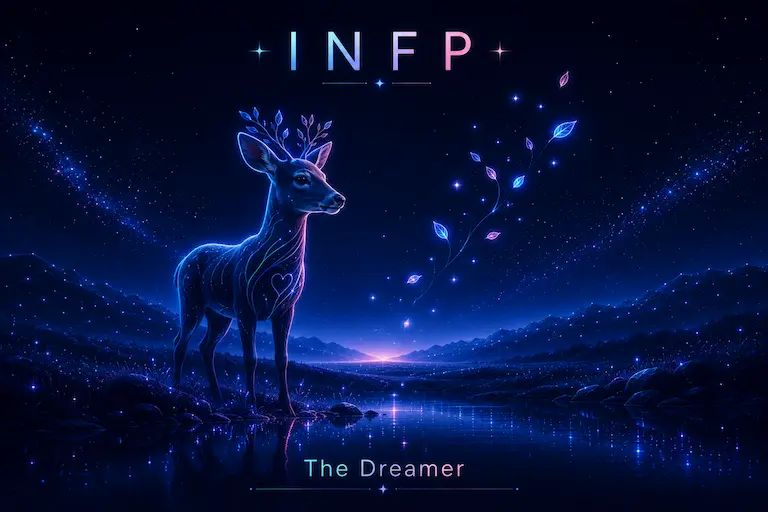
INFPs (Dreamers) are value-guided explorers who automatically notice when experiences align with or violate their deepest convictions (Fi), then follow multiple hypothetical paths (Ne) while checking every choice against inner congruence (Fi). They carry a vivid internal compass (Fi) and measure the outer world against it without needing external validation or measurable outcomes (Te).
They notice hidden possibilities (Ne) and alternative interpretations yet remain anchored by whether a direction feels personally true or hollow (Fi). When a path diverges from core values (Fi) they change course even at personal cost, preferring to let interpersonal dynamics unfold naturally rather than shape them toward group harmony (Fe) or measurable output (Te).
Beneath gentle openness lies a firm inner standard (Fi) that resists pressure. They would rather preserve perfect congruence (Fi) than accept solutions that merely produce results others respect or meet practical requirements (Te).
Common misconception: INFPs are not indecisive idealists; their gentleness protects a quietly immovable inner compass (Fi) that activates automatically and guides them through branching possibilities (Ne) toward what feels deeply right.
Cultural archetype: The deer reflects this type’s symbolic pattern: Gentle, soulful, sensitive, and symbolically pure, the deer reflects INFP sincerity, tenderness, and quiet resilience. In popular typology discussions, figures sometimes associated with INFP include J.R.R. Tolkien, Virginia Woolf, and Vincent van Gogh.
INFPs begin with whether something resonates with personal values (Fi), then explore wide-ranging connections and what-if scenarios (Ne).
Dominant introverted feeling (Fi) automatically registers alignment or violation of inner standards, while auxiliary extraverted intuition (Ne) tracks emerging possibilities, hidden interpretations, and linking ideas. They prefer experimenting with fresh approaches (Ne) over rigid precedents (Si) and set aside group expectations (Fe) in favour of authenticity (Fi).
They grow when they deliberately apply measurable outcomes (Te) and reliable structures (Si) to turn inspiration into completed work without losing inner congruence (Fi).
INFPs flourish when purpose, creativity, autonomy, and value alignment (Fi) coexist.
They are drawn to writing, counselling, design, education, advocacy, the arts, and mission-driven roles where imagination (Ne) serves genuine meaning (Fi). They contribute best when allowed to follow personal resonance (Fi) rather than enforce efficiency or productivity metrics (Te).
They may delay when work feels misaligned (Fi). Clear yet humane priorities (Te) and room for experimentation (Ne) help translate conviction into tangible contribution.
INFPs achieve a state of flow when all four functions operate in tandem during activities such as composing a personal essay that explores value-aligned possibilities (Fi and Ne), drawing on childhood memories for authenticity (Si), and editing the piece into publishable form (Te), or designing a community project that translates inner convictions into practical steps while remaining open to emergent ideas.
AI flourishing:
INFPs can use AI to move from private value (Fi) to shareable form: generating outlines, clustering possibilities (Ne), testing emotional tone, and reducing the friction between inner resonance (Fi) and outer expression.
With mechanical translation eased, energy turns toward lived authenticity: creative practice, advocacy, mutual aid, reflective writing, nature connection (Si), and projects that help others name what matters without simulation or external pressure (Te).
The promise depends on keeping choice personal (Fi) rather than manufactured. Used poorly, AI could dilute sincerity into scalable content (Te); used wisely, it grants courage to embody values (Fi), inhabit presence (Se), and contribute meaningfully in the real world.
INFPs connect through authenticity (Fi), emotional safety, and the freedom to explore meaning without performance (Fe).
They listen for what feels true beneath words and notice when someone is out of alignment with their own values (Fi). This creates gentle, perceptive companionship that rarely imposes harmony (Fe) or practical requirements (Te).
They protect their inner world (Fi) until trust is deep. Relationships deepen when their convictions (Fi) are respected and possibilities (Ne) can be explored together without dismissal.
Relational pattern:
In relationships they like to give deep empathy, imaginative companionship (Ne), unwavering loyalty to shared values (Fi), and a safe space for the other person’s authentic self-expression without judgement.
They like to receive acceptance of their inner world (Fi), freedom to explore possibilities (Ne) without pressure to produce results (Te), gentle encouragement that honours their pace, and consistent respect for their personal boundaries and convictions.
They fear environments that demand inauthenticity or force them to betray core values, emotional invalidation of their inner world, and loss of autonomy in relationships. They love connections that honour their unique perspective, encourage playful exploration of meaning, and provide gentle acceptance that allows their convictions to unfold naturally.
Mistyping notes:
INFPs are often confused with INFJs because both seem deep and idealistic. INFPs begin with personal value congruence (Fi) and branch into multiple hypothetical futures (Ne), whereas INFJs converge on single emerging patterns (Ni) and emotional trajectories (Fe) to restore group goodwill.
They may resemble ISFPs in gentleness and authenticity (Fi). ISFPs stay anchored in immediate sensory experience (Se) and aesthetic fit, while INFPs wander through symbolic possibilities (Ne), imagined alternatives, and inner moral alignment (Fi).
With ENFPs the shared functions (Fi and Ne) create lively overlap. ENFPs externalise possibilities rapidly through people and visible enthusiasm, whereas INFPs guard a quieter core (Fi) and reveal convictions more selectively.
Shadow pattern:
Shadow functions refer to the four less conscious functions operating in the opposite attitude to the primary stack; they tend to emerge under stress, often as projection or disruptive behaviour, revealing aspects of the personality that have been neglected.
The anima (the unconscious feminine aspect in a man) or animus (the unconscious masculine aspect in a woman) is a Jungian archetype typically carried by the inferior function; it frequently appears in dreams, projections onto others, or moments of strong attraction, acting as a bridge to deeper unconscious material.
For INFPs, the shadow first appears through opposing extraverted sensing (Se) that drives impulsive or hedonistic behaviour without value grounding (Fi) and critical parent introverted intuition (Ni) that produces dark tunnel-visioned forecasts.
It can also appear through trickster extraverted thinking (Te) that appears as blunt criticism or chaotic control and demon introverted sensing (Si) that generates overwhelming negative body memories or rigid tradition fixation.
Integrating the anima or animus through inferior extraverted thinking (Te) invites decisive action, objective prioritisation, and structured accomplishment, softening shadow eruptions and bringing greater balance between inspiration (Ne) and completion, realism (Si), and assertive effectiveness in the outer world.
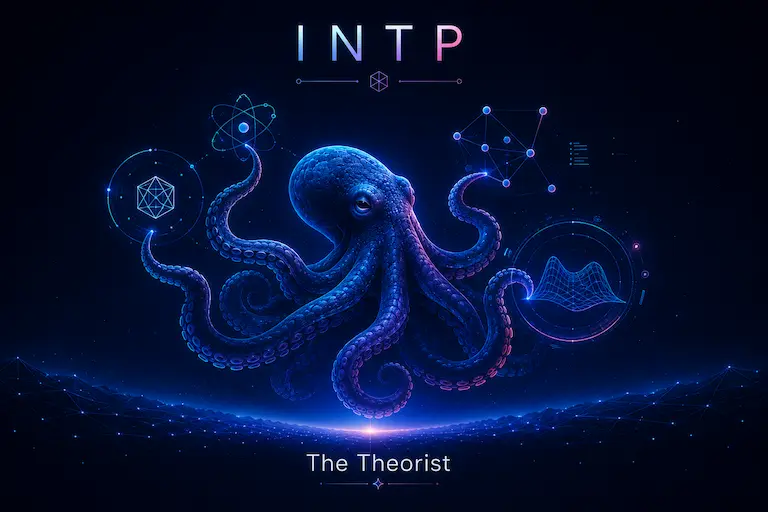
INTPs (Theorists) are precision-building analysts who automatically notice logical gaps, contradictions (Ti), and imprecise meanings, then explore branching possibilities (Ne) while checking every model for internal coherence (Ti). They quietly assemble and test frameworks in private, preferring elegance over immediate usefulness (Te) or social acceptance (Fe).
They track exact relationships between ideas (Ti) and identify fundamental principles that make a system hang together. When something mostly works they may still address small inconsistencies (Ti), yet they resist enforcing measurable outcomes (Te) or structured plans if exploration (Ne) feels more promising.
Independent and exacting (Ti), they would rather admit uncertainty than defend a framework that fails internal scrutiny (Ti). This gives them unusual honesty about the limits of knowledge and pleasure in the moment a tangled model finally resolves cleanly.
Common misconception: INTPs are not indifferent; they care deeply about accurate understanding and automatically analyse for consistency (Ti), often questioning even their own best constructions as a form of respect.
Cultural archetype: The octopus reflects this type’s symbolic pattern: Curious, flexible, puzzle-solving, and hard to box in, the octopus suits INTPs because it suggests inventive intelligence rather than conventional status. In popular typology discussions, figures sometimes associated with INTP include Albert Einstein, Charles Darwin, and Marie Curie.
INTPs disassemble explanations to verify whether every definition and relationship holds together internally (Ti).
Dominant introverted thinking (Ti) automatically detects contradictions and tracks precise logical connections, while auxiliary extraverted intuition (Ne) generates alternative interpretations, hidden possibilities, and what-if scenarios. They prefer elegant theoretical frameworks (Ti) over merely practical solutions that others respect (Te).
They develop by deliberately incorporating reliable past precedents (Si) and attending to emotional climate (Fe) when logic alone leaves important data unexamined.
INTPs excel when given complex problems, intellectual autonomy (Ti), and freedom from micromanagement (Te).
They gravitate toward research, software architecture, systems analysis, technical writing, philosophy, mathematics, and any domain where conceptual precision (Ti) creates real leverage. They perform best when allowed to question assumptions (Ne) before committing to structured plans (Te).
Flexible timelines and clear but minimal process (Si) help translate elegant models (Ti) into finished, testable results.
INTPs achieve a state of flow when all four functions operate in tandem during activities such as debugging a complex algorithm by exploring multiple logical pathways (Ti and Ne), cross-referencing historical data for consistency (Si), and collaborating with a colleague to explain the solution clearly (Fe), or building a theoretical framework for a scientific paper that is then tested through practical simulation.
AI flourishing:
INTPs can use AI to accelerate information synthesis, counter-example generation (Ti), model comparison (Ne), and exploratory branching, freeing cognitive resources for deeper inquiry.
With routine labour reduced, attention turns toward wonder, open-ended teaching, playful theory construction (Ti), intellectual humility, and understanding that enriches life rather than merely winning debates (Fe).
The promise depends on humans retaining responsibility for why questions matter (Fi). Used poorly, AI could replace active questioning (Ti) with plausible summaries; used wisely, it supports clearer thought, real-world testing (Se), and shared pursuit of truthful insight.
INTPs connect through curiosity, intellectual honesty (Ti), and conversations free of pressure to perform or maintain harmony (Fe).
They demonstrate care by exploring how someone thinks, solving logical problems (Ti), or quietly protecting autonomy. They value partners who engage their tangents (Ne) without demanding emotional smoothing (Fe) or measurable social output (Te).
Trust grows slowly through consistency and directness. Relationships improve when questions (Ti) are welcomed rather than interpreted as rejection or disruption of climate (Fe).
Relational pattern:
In relationships they like to give intellectual companionship, honest analysis (Ti), playful exploration of ideas (Ne), and the freedom for both people to remain independent while sharing curiosity.
They like to receive respect for their need for autonomy, engaging conversation that values precision (Ti) without forcing emotional performance (Fe), patience with their indirect expression of care, and partners who can laugh at absurdity alongside them.
They fear emotional overwhelm that disrupts logical clarity, superficial small talk that wastes mental energy, and relationships that demand constant social performance. They love connections offering intellectual freedom, mutual respect for independence, dry humour, and the chance to explore complex ideas without pressure to conform emotionally.
Mistyping notes:
INTPs are often confused with INTJs because both are independent and analytically serious. INTPs organise around internal logical consistency (Ti) and elegant frameworks, whereas INTJs organise around measurable outcomes (Te), resource efficiency, and strategic trajectories (Ni).
They may resemble ISTPs in technical detachment. ISTPs test through immediate sensory feedback (Se) and practical adaptation, while INTPs begin with conceptual precision (Ti) and branching hypothetical exploration (Ne).
Compared with ENTPs, INTPs are more internally exacting (Ti). ENTPs test ideas outwardly through rapid debate and social experimentation (Fe), whereas INTPs refine privately until the model feels internally coherent.
Shadow pattern:
Shadow functions refer to the four less conscious functions operating in the opposite attitude to the primary stack; they tend to emerge under stress, often as projection or disruptive behaviour, revealing aspects of the personality that have been neglected.
The anima (the unconscious feminine aspect in a man) or animus (the unconscious masculine aspect in a woman) is a Jungian archetype typically carried by the inferior function; it frequently appears in dreams, projections onto others, or moments of strong attraction, acting as a bridge to deeper unconscious material.
For INTPs, the shadow first appears through opposing extraverted feeling (Fe) that floods with awkward emotionality or people-pleasing and critical parent introverted intuition (Ni) that imposes dark singular visions.
It can also appear through trickster extraverted sensing (Se) that produces impulsive physical acting-out or sensory overload and demon introverted thinking (Ti) that turns hyper-critical and inwardly destructive.
Integrating the anima or animus through inferior extraverted feeling (Fe) invites connection, group harmony, and expressive warmth, reducing isolation, softening intellectual rigidity (Ti), and allowing more fluid, compassionate engagement with others and the physical world (Se).
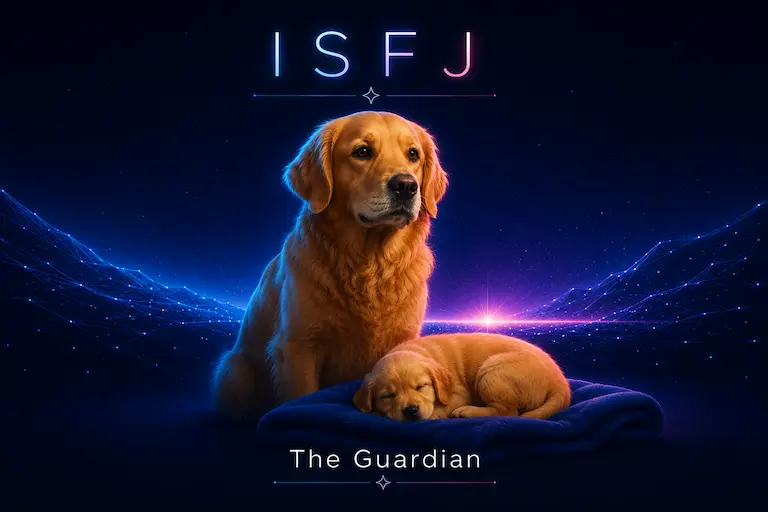
ISFJs (Guardians) are reliable caretakers who automatically recall past impressions and reliable precedents (Si), then check new situations against them while tracking everyone’s emotional tone (Fe) to maintain steady belonging. They keep communities functioning through quiet, consistent attention to what has proven supportive before (Si).
They notice when current experiences evoke familiar memories (Si), adjust approaches based on what has worked reliably (Si), and work to restore goodwill when connection falters (Fe). They prefer tried-and-true methods (Si) over novel possibilities (Ne) and focus on concrete sensory details (Se) only when they become hard to ignore.
Much of their contribution remains invisible because it is so dependable: remembering preferences (Si), anticipating discomfort (Fe), and sustaining the small routines that let people feel safely held without demanding constant measurable outcomes (Te) or branching exploration (Ne).
Common misconception: ISFJs are not passively compliant; they automatically draw on past impressions (Si) and long-term commitment to emotional harmony (Fe), choosing loyalty with a quiet strength that often exceeds first appearances.
Cultural archetype: The golden retriever reflects this type’s symbolic pattern: Loyal, nurturing, steady, kind, and universally loved, the golden retriever makes ISFJ devotion and caretaking feel admirable, warm, and emotionally safe. In popular typology discussions, figures sometimes associated with ISFJ include Mother Teresa, Rosa Parks, and Kate Middleton.
ISFJs compare the present against a rich store of firsthand precedent and familiar impressions (Si).
Dominant introverted sensing (Si) automatically brings reliable memories to mind, while auxiliary extraverted feeling (Fe) tracks emotional climate, notices when harmony breaks, and works to restore shared positivity. Tertiary introverted thinking (Ti) checks for logical inconsistencies within established methods.
They excel at prevention by remembering what once caused discomfort (Si). Growth arrives when they deliberately explore emerging possibilities (Ne) without treating every novelty as a threat to continuity (Si).
ISFJs bring steadiness, conscientious care (Fe), and accurate memory (Si) to roles that support others.
They suit healthcare, education, administration, counselling support, operations, and community service where proven methods (Si) and emotional attunement (Fe) maintain smooth functioning without insistence on disruptive innovation (Ne).
They thrive with clear expectations (Ti), genuine appreciation (Fe), and permission to set boundaries before generosity becomes depletion.
ISFJs achieve a state of flow when all four functions operate in tandem during activities such as organising a family gathering that draws on past traditions (Si), anticipates everyone’s emotional needs (Fe), checks for logical consistency in the schedule (Ti), and adapts spontaneously to last-minute changes (Ne), or meticulously preparing a community archive that blends historical accuracy with caring presentation.
AI flourishing:
ISFJs can use AI to handle repetitive care logistics (Si): reminders, documentation, scheduling, checklists, and tracking of preferences so attention stays on human connection (Fe).
With administrative load lightened, energy turns toward chosen devotion: family presence, local mentoring, hospitality, craft, health support, and face-to-face care (Se) that cannot be automated.
The promise depends on preserving the human warmth (Fe) within support systems. Used poorly, AI could raise expectations of endless availability (Fe); used wisely, it protects time, boundaries (Fi), and genuine presence (Se) so generosity remains sustainable and personal.
ISFJs connect through practical loyalty (Si), remembered details, and quiet restoration of comfort (Fe).
They automatically notice what someone needs before it is spoken (Fe) and sustain traditions that give relationships continuity (Si). Small consistent gestures form their natural language of care.
They may hesitate to voice personal limits (Fi). Bonds deepen when others value both their helpfulness (Fe) and their honest boundaries.
Relational pattern:
In relationships they like to give dependable support, thoughtful remembrance of details (Si), consistent emotional steadiness (Fe), and practical acts of service that create security and continuity.
They like to receive sincere appreciation, reciprocity of care (Fe), respect for their need for stability (Si), and gentle encouragement to voice personal needs without fear of disappointing others.
They fear sudden disruption of established routines, being taken for granted after years of service, and loss of emotional harmony in close relationships. They love reliable, reciprocal care, appreciation for their quiet loyalty, and the comfort of traditions that strengthen belonging over time.
Mistyping notes:
ISFJs are often mistaken for INFJs because both are caring and attentive to unspoken needs (Fe). ISFJs rely on accumulated precedent (Si), reliable impressions, and concrete emotional maintenance, whereas INFJs read through converging long-term patterns (Ni) and anticipatory insight.
They can resemble ISTJs in dependability. ISTJs organise around measurable standards (Te) and practical accountability first, while ISFJs filter responsibility through emotional climate (Fe) and restoration of group warmth.
Compared with ESFJs, ISFJs offer care more privately and selectively (Si). ESFJs coordinate visibly across larger groups and social rhythms (Fe), whereas ISFJs sustain steadiness through quieter, personal acts of continuity (Si).
Shadow pattern:
Shadow functions refer to the four less conscious functions operating in the opposite attitude to the primary stack; they tend to emerge under stress, often as projection or disruptive behaviour, revealing aspects of the personality that have been neglected.
The anima (the unconscious feminine aspect in a man) or animus (the unconscious masculine aspect in a woman) is a Jungian archetype typically carried by the inferior function; it frequently appears in dreams, projections onto others, or moments of strong attraction, acting as a bridge to deeper unconscious material.
For ISFJs, the shadow first appears through opposing extraverted intuition (Ne) that leads to scattered worry or catastrophic hypothetical spirals and critical parent introverted thinking (Ti) that becomes coldly analytical and self-blaming.
It can also appear through trickster extraverted feeling (Fe) that produces awkward or manipulative social performances and demon introverted sensing (Si) that locks them into bodily pain or traumatic memory loops.
Integrating the anima or animus through inferior extraverted intuition (Ne) invites playful exploration of new possibilities and flexible perspective-taking, easing shadow grip, expanding beyond rigid duty (Si), and bringing greater creativity, self-compassion (Fi), and openness to uncertainty.

ISTJs (Inspectors) are steadfast standard-keepers who automatically consult past experience and reliable precedents (Si), then track efficiency (Te), missing resources, and whether systems produce intended results. They organise responsibilities so obligations remain unambiguous and outcomes can be measured against proven methods (Si).
They notice when current demands diverge from what has repeatedly worked (Si), push for clear goals and decisive follow-through (Te), and prefer practical requirements (Te) over personal value exploration (Fi) or branching possibilities (Ne). They leave small inconsistencies alone only when overall results remain acceptable (Te).
Reserved yet thoroughly dependable, they become the quiet anchors others rely upon when accuracy, continuity (Si), and accountability (Te) truly matter. A commitment given is a commitment kept to specification (Si).
Common misconception: ISTJs are not inherently resistant to change; they automatically reference accumulated experience (Si) and long-term efficiency (Te), supporting reform once it demonstrates it will uphold responsibility and verifiable results.
Cultural archetype: The badger reflects this type’s symbolic pattern: Steady, industrious, principled, and quietly formidable, the badger honours ISTJs’ groundedness, work ethic, and “do not test me on the rules” backbone. In popular typology discussions, figures sometimes associated with ISTJ include George Washington, Queen Elizabeth II, and Warren Buffett.
ISTJs ground decisions in verified precedent and observed outcomes (Si) rather than abstract models (Ni) or sudden insights.
Dominant introverted sensing (Si) automatically recalls what has proven reliable, while auxiliary extraverted thinking (Te) tracks efficiency, spots gaps, and enforces measurable standards and decisive action. Tertiary introverted feeling (Fi) checks whether choices align with inner values rather than mere group expectations (Fe).
They identify gaps between promise and delivery quickly (Te). Growth comes from deliberately exploring divergent options (Ne) before dismissing them for lacking precedent (Si).
ISTJs bring order, precision (Si), and dependable execution (Te) to any domain requiring accountability.
They suit logistics, compliance, quality control, operations, accounting, project management, and institutional roles where proven methods (Si) protect against costly error. They maintain standards others eventually rely upon without fanfare (Fi).
They perform best with consistent authority (Te), clear metrics, and environments that reward follow-through rather than constant reinvention (Ne).
ISTJs achieve a state of flow when all four functions operate in tandem during activities such as conducting a thorough audit that cross-references historical records (Si), enforces clear standards (Te), aligns with personal principles of fairness (Fi), and adapts to new regulatory requirements with practical innovation (Ne), or overseeing a complex logistics operation that runs smoothly because every detail has been anticipated from past experience.
AI flourishing:
ISTJs can use AI to automate repetitive verification (Si), record comparison, compliance scanning, scheduling, and procedural updates, preserving accuracy with less manual effort (Te).
With routine labour reduced, attention moves toward meaningful stewardship: civic responsibility, craft mastery, family stability, institutional trust (Fi), and practical contributions that honour continuity (Si) while serving real people.
The promise depends on automation reinforcing rather than obscuring accountability (Te). Used poorly, AI could create opaque systems no one owns; used wisely, it frees judgement (Fi) for honourable duty, local service, and standards worth preserving.
ISTJs connect through consistency (Si), practical reliability (Te), and shared respect for responsibility.
They demonstrate care by remembering obligations (Si), being present when needed, and ensuring important matters are handled correctly (Te) rather than through frequent emotional restoration (Fe) or exploratory conversation (Ne).
They value direct communication and predictable behaviour (Si). Trust builds slowly through action and is sustained by follow-through far more than words.
Relational pattern:
In relationships they like to give steadfast reliability, practical support (Te), consistent follow-through on commitments (Si), and quiet protection of shared stability and fairness.
They like to receive dependable honesty, respect for their sense of duty (Si), clear communication without emotional volatility (Fe), and appreciation for their behind-the-scenes steadiness.
They fear unreliability that undermines trust, chaotic change without clear justification, and emotional unpredictability that disrupts order. They love relationships grounded in consistency, mutual respect for duty, quiet appreciation, and the security of knowing commitments will be honoured.
Mistyping notes:
ISTJs are often mistaken for ISFJs due to shared reliability and memory (Si). ISTJs prioritise measurable results (Te), clear accountability, and efficient structures, whereas ISFJs filter decisions through emotional climate (Fe), comfort, and restoration of goodwill.
They can resemble INTJs in scepticism of unproven ideas. INTJs trust converging long-range models (Ni), while ISTJs demand precedent, verified data (Si), and procedures that have repeatedly delivered results (Te).
Compared with ESTJs, ISTJs enforce order more quietly through personal discipline (Si). ESTJs coordinate people, timelines, and standards more visibly and directively in real time (Te).
Shadow pattern:
Shadow functions refer to the four less conscious functions operating in the opposite attitude to the primary stack; they tend to emerge under stress, often as projection or disruptive behaviour, revealing aspects of the personality that have been neglected.
The anima (the unconscious feminine aspect in a man) or animus (the unconscious masculine aspect in a woman) is a Jungian archetype typically carried by the inferior function; it frequently appears in dreams, projections onto others, or moments of strong attraction, acting as a bridge to deeper unconscious material.
For ISTJs, the shadow first appears through opposing extraverted intuition (Ne) that generates anxious what-if scenarios or scattered rebellion and critical parent extraverted feeling (Fe) that becomes overly concerned with social image or sudden people-pleasing.
It can also appear through trickster introverted thinking (Ti) that produces obsessive internal criticism or nitpicking and demon extraverted thinking (Te) that turns ruthlessly controlling or explosively directive.
Integrating the anima or animus through inferior extraverted intuition (Ne) invites flexibility, curiosity about novel possibilities, and playful reframing, easing shadow pressure, softening rigid duty (Si), and opening greater creativity, emotional nuance (Fe), and adaptive problem-solving.
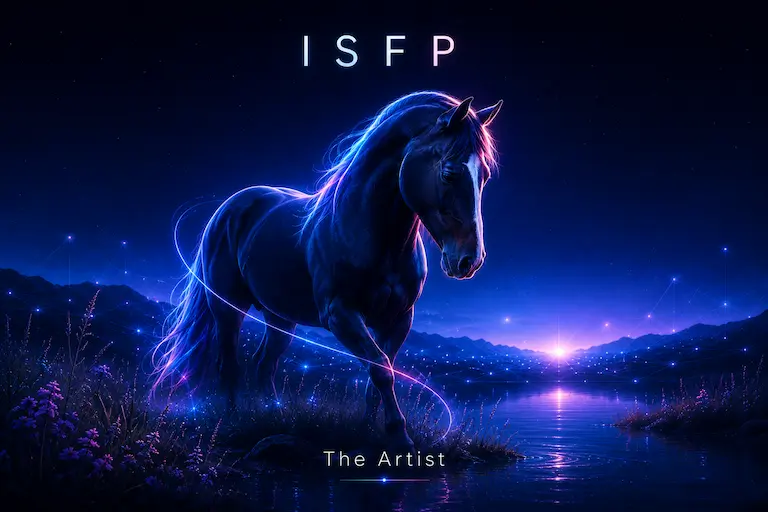
ISFPs (Artists) are value-anchored perceivers who automatically register when experiences align with or violate personal meaning (Fi), then respond fluidly to immediate sensory reality (Se) while staying congruent with inner authenticity (Fi). They live close to direct sensation (Se) and trust felt resonance (Fi) more than abstract models (Ni) or group expectations (Fe).
They notice physical details (Se), moment-to-moment shifts, and whether something feels genuinely right or subtly wrong (Fi), often adapting instinctively without explaining in logical terms (Te). They prefer letting dynamics unfold naturally rather than pushing measurable outcomes (Te) or branching into ungrounded hypotheticals (Ne).
Beneath unassuming presence they maintain firm personal standards (Fi) that are difficult to override. They express convictions more readily through crafted action, aesthetic choices (Se), and quiet integrity than through declarative statements or enforced plans (Te).
Common misconception: ISFPs are not directionless; an automatic inner compass (Fi) activates without effort, guiding them through present sensory reality (Se) toward choices that preserve personal congruence even when invisible to others.
Cultural archetype: The horse reflects this type’s symbolic pattern: Beautiful, sensitive, expressive, and quietly powerful, the horse reflects ISFP aesthetic individuality, emotional depth, grace, and presence. In popular typology discussions, figures sometimes associated with ISFP include Frida Kahlo, Michael Jackson, and Prince.
ISFPs evaluate through immediate personal resonance (Fi) and unfiltered sensory input (Se).
Dominant introverted feeling (Fi) automatically detects alignment with deepest values, while auxiliary extraverted sensing (Se) tracks sights, sounds, bodily sensations, and sudden shifts, adapting actions instinctively to what the moment requires. They focus on tangible qualities (Se) rather than distant patterns (Ni) or efficiency metrics (Te).
They develop by deliberately incorporating convergent insights (Ni) and objective prioritisation (Te) that protect what they value over longer arcs.
ISFPs thrive in hands-on, autonomous, or aesthetically driven roles where impact is tangible (Se).
They suit design, craftsmanship, performance, healing arts, environmental work, animal care, and practical creative fields. They produce their best work when allowed to follow felt authenticity (Fi) and immediate feedback (Se) rather than rigid productivity structures (Te).
They need variety (Se), respectful autonomy (Fi), and enough flexible organisation (Te) to prevent inspiration from scattering without crushing spontaneity.
ISFPs achieve a state of flow when all four functions operate in tandem during activities such as painting a landscape that captures a precise emotional resonance (Fi and Se), allowing intuitive composition to emerge (Ni), and methodically selecting materials and finishing the piece with practical skill (Te), or crafting a handmade object that perfectly balances personal meaning with functional beauty in the workshop.
AI flourishing:
ISFPs can use AI to prototype ideas (Ni), compare materials (Se), simulate outcomes, and handle logistics (Te) so hands and senses remain free for direct creation.
With preparatory friction reduced, energy returns to embodied engagement: making, repairing, gardening, movement, music, bodywork (Se), and the crafting of environments that feel alive and congruent (Fi).
The promise depends on taste and integrity staying rooted in lived sensation (Se). Used poorly, AI could distance them from direct experience (Se); used wisely, it clears space for beauty, repair, presence (Se), and contribution that can only be felt in the body and the moment.
ISFPs connect through presence (Se), warmth, shared sensory experience, and respect for personal authenticity (Fi).
They notice subtle atmospheres (Se) and adapt quietly to create comfort or beauty without imposing harmony (Fe) or long-term forecasts (Ni). They show care through gesture, atmosphere, and genuine congruence (Fi) rather than explanation (Te).
They may retreat when pressed for justification (Te). Relationships deepen when values (Fi) are honoured without demand for constant logical articulation or measurable progress (Te).
Relational pattern:
In relationships they like to give gentle presence, aesthetic attunement (Se), loyal acceptance of the other’s uniqueness (Fi), and spontaneous acts of kindness or beauty that nurture the shared moment.
They like to receive non-intrusive respect for their inner world (Fi), freedom to respond in their own time and way (Se), appreciation without pressure to explain feelings, and consistent emotional safety that never demands performance or logical defence.
They fear being forced to explain or justify their feelings before they are ready, environments that stifle authenticity or spontaneity, and relationships that demand constant verbal processing. They love quiet acceptance of their unique perspective, shared sensory experiences that feel alive and real, freedom to express without words, and gentle companionship that honours their inner rhythm.
Mistyping notes:
ISFPs are often mistaken for INFPs due to shared authenticity (Fi) and gentleness. ISFPs remain anchored in immediate sensory feedback (Se) and aesthetic judgement, whereas INFPs explore symbolic meaning (Ni), alternative futures (Ne), and hypothetical moral alignments (Fi).
They can resemble ISTPs in quiet independence. ISTPs analyse mechanical leverage and practical efficiency (Ti), while ISFPs are guided by personal value resonance (Fi), felt beauty (Se), and whether an action feels inwardly right.
Compared with ESFPs, ISFPs express more selectively and privately (Fi). ESFPs broadcast warmth and presence outwardly in real time (Se), whereas ISFPs reveal inner world through crafted choices, style, and subtle environments.
Shadow pattern:
Shadow functions refer to the four less conscious functions operating in the opposite attitude to the primary stack; they tend to emerge under stress, often as projection or disruptive behaviour, revealing aspects of the personality that have been neglected.
The anima (the unconscious feminine aspect in a man) or animus (the unconscious masculine aspect in a woman) is a Jungian archetype typically carried by the inferior function; it frequently appears in dreams, projections onto others, or moments of strong attraction, acting as a bridge to deeper unconscious material.
For ISFPs, the shadow first appears through opposing extraverted thinking (Te) that becomes controlling or harshly critical and critical parent introverted intuition (Ni) that produces bleak singular visions and obsessive foresight.
It can also appear through trickster extraverted feeling (Fe) that creates awkward social performances or sudden people-pleasing and demon introverted thinking (Ti) that turns inwardly hyper-analytical and self-destructive.
Integrating the anima or animus through inferior extraverted thinking (Te) invites decisive action, objective structure, and effective execution, softening shadow intensity, strengthening boundary-setting, and allowing the type to bring their authentic values (Fi) and sensory gifts (Se) into wider, more impactful contribution without losing integrity.
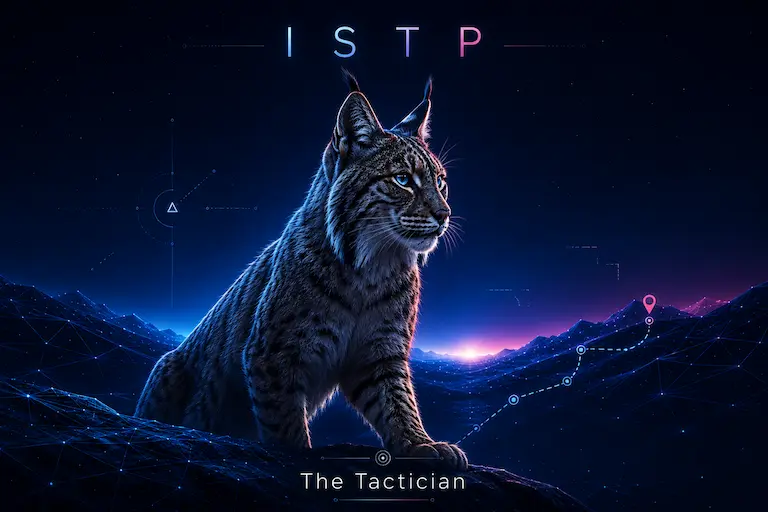
ISTPs (Tacticians) are precise troubleshooters who automatically notice logical inconsistencies and mechanical relationships (Ti), then respond to immediate physical changes (Se) with calm, adaptive experimentation. They diagnose what is not working and adjust in real time rather than following fixed plans (Ni) or group emotional expectations (Fe).
They track moment-to-moment shifts (Se), instinctively adapt actions when conditions change, and prefer practical solutions that produce results (Te) over elegant theories (Ni) or restoring collective warmth (Fe). When something mostly works they tolerate small inconsistencies if overall function remains intact (Ti).
Self-directed and composed (Ti), they trust direct feedback from the environment (Se) more than accumulated precedent (Si) or long-range forecasts (Ni). They excel when given a concrete problem, tools, and freedom to improvise without unnecessary explanation (Fe).
Common misconception: ISTPs are not uncaring; they automatically analyse for logical precision (Ti) and register physical reality (Se) without effort, demonstrating regard through competent action and calm problem-solving rather than emotional soothing (Fe).
Cultural archetype: The lynx reflects this type’s symbolic pattern: Solitary, precise, silent, athletic, and unflappable, the lynx gives ISTPs a self-contained tactical elegance: the lone specialist who appears only when needed. In popular typology discussions, figures sometimes associated with ISTP include Clint Eastwood, Bruce Lee, and Amelia Earhart.
ISTPs isolate variables, test what currently functions, and adjust based on immediate feedback (Se).
Dominant introverted thinking (Ti) automatically detects contradictions and tracks exact logical relationships, while auxiliary extraverted sensing (Se) registers sights, sounds, and moment-to-moment changes, adapting actions fluidly. They focus on practical leverage (Ti) over abstract patterns (Ni) or group harmony (Fe).
They remain composed because they trust present feedback (Se). Growth means deliberately incorporating convergent insights (Ni) and attending to emotional climate (Fe) before technically correct moves create unnecessary distance.
ISTPs excel in roles demanding diagnostic skill (Ti), autonomy, and real-time adaptation (Se).
They suit trades, engineering, emergency response, IT diagnostics, fieldwork, technical sports, and any environment where immediate problem-solving carries tangible stakes. They thrive when competence is tested against live conditions (Se) rather than bureaucracy (Si).
They prefer clear outcomes (Te), minimal oversight, and opportunities for hands-on experimentation (Se) that prevent restlessness.
ISTPs achieve a state of flow when all four functions operate in tandem during activities such as troubleshooting a malfunctioning engine by analysing mechanical principles (Ti), observing real-time symptoms (Se), sensing the likely root cause (Ni), and calmly explaining the fix to a colleague (Fe), or improvising a field repair during an outdoor expedition that combines precise diagnosis with adaptive tool use.
AI flourishing:
ISTPs can use AI to speed diagnosis (Ti), simulate variables (Se), compare components, generate troubleshooting paths, and reduce lookup time so attention stays on live systems.
With preparatory work lightened, energy returns to embodied mastery: building, repairing, navigating uncertainty (Se), mentoring through action, and the satisfaction of competence proven against physical reality.
The promise depends on keeping final judgement grounded in lived conditions (Se). Used poorly, AI could foster over-reliance on abstract answers (Ni); used wisely, it sharpens timing, safety, and calm effectiveness under pressure (Ti).
ISTPs connect through shared activity (Se), dry humour, competence (Ti), and low-pressure honesty.
They show care by solving immediate problems (Ti), offering practical help, or creating space for independence rather than tracking collective mood (Fe) or restoring group warmth. Bonds often form side-by-side during tasks (Se).
They need personal autonomy (Fi) and may withdraw if emotions feel managed (Fe). Closeness grows when action, trust, and direct feedback matter as much as conversation.
Relational pattern:
In relationships they like to give practical help, calm competence (Ti), shared adventures (Se), and loyal presence that shows up reliably when needed without unnecessary emotional elaboration (Fe).
They like to receive respect for independence, low-key companionship that enjoys activity (Se), honest feedback without drama (Fe), and partners who appreciate their problem-solving style without trying to change it.
They fear emotional manipulation or being smothered by expectations, loss of autonomy, and relationships that prioritise talk over action. They love straightforward honesty, shared practical adventures, quiet acceptance of their independence, and partners who can engage in activities without demanding constant verbal processing.
Mistyping notes:
ISTPs are often mistaken for INTPs because both value precision (Ti) and independence. ISTPs test through direct sensory engagement (Se) and immediate practical variables, whereas INTPs refine conceptual definitions and internal logical elegance (Ti) before acting.
They can resemble ISFPs in quiet adaptability. ISFPs follow personal value resonance (Fi) and aesthetic fit, while ISTPs prioritise mechanical accuracy (Ti), leverage, and the simplest effective intervention.
Compared with ESTPs, ISTPs are more diagnostically contained (Ti). ESTPs seize social opportunities and read live interpersonal leverage (Fe), whereas ISTPs analyse mechanisms first and act when the technical move is clear.
Shadow pattern:
Shadow functions refer to the four less conscious functions operating in the opposite attitude to the primary stack; they tend to emerge under stress, often as projection or disruptive behaviour, revealing aspects of the personality that have been neglected.
The anima (the unconscious feminine aspect in a man) or animus (the unconscious masculine aspect in a woman) is a Jungian archetype typically carried by the inferior function; it frequently appears in dreams, projections onto others, or moments of strong attraction, acting as a bridge to deeper unconscious material.
For ISTPs, the shadow first appears through opposing extraverted intuition (Ne) that generates scattered anxious possibilities or paranoid forecasting (Ni) and critical parent introverted feeling (Fi) that turns self-righteous or emotionally volatile.
It can also appear through trickster extraverted feeling (Fe) that produces clumsy or explosive social expressions and demon introverted intuition (Ni) that generates dark singular visions or fatalistic certainty.
Integrating the anima or animus through inferior extraverted intuition (Ne) invites openness to multiple perspectives, playful idea exploration, and flexible future orientation, softening shadow rigidity (Ti), expanding emotional range (Fe), and allowing broader contextual awareness for more balanced action in complex situations.
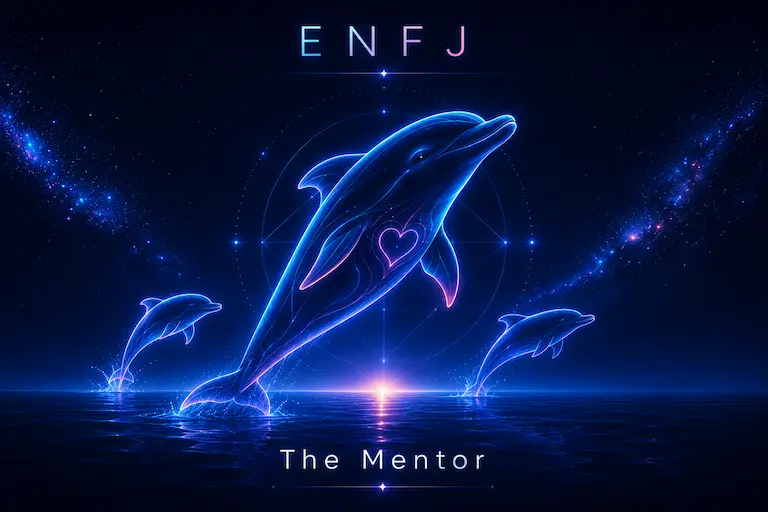
ENFJs (Mentors) are harmony-guiding catalysts who automatically register others’ emotional needs and the group atmosphere (Fe), then track where current trajectories are heading (Ni) so they can restore goodwill, encourage growth, and align people toward shared meaning. They feel responsible for helping potential unfold in both individuals and communities (Fe).
They notice when connection breaks (Fe) and work to rebuild rapport, adjust their approach to keep the social climate positive (Fe), and reorganise understanding around strong insights about human trajectories (Ni). They prefer collaboration and long-term development (Ni) over insisting on perfect logical consistency (Ti) or solitary exploration (Ne).
This orientation produces sincere investment in others’ becoming (Ni), though it can lead to over-responsibility for feelings that are not theirs to carry (Fe). Their warmth is often automatic and rooted in genuine care rather than performance.
Common misconception: ENFJs are not performing warmth; they automatically register what others feel and need (Fe), using long-term pattern synthesis (Ni) to guide groups toward growth while deliberately focusing to achieve logical clarity (Ti) when required.
Cultural archetype: The dolphin reflects this type’s symbolic pattern: Warm, socially intelligent, cooperative, emotionally responsive, and widely beloved, the dolphin suits ENFJs because it combines friendliness, leadership, and group harmony. In popular typology discussions, figures sometimes associated with ENFJ include Martin Luther King Jr., Nelson Mandela, and Oprah Winfrey.
ENFJs track the emotional field (Fe) and the likely direction of relationships or communities at once (Ni).
Dominant extraverted feeling (Fe) automatically registers tone, needs, and breaks in connection, working to restore harmony and shared positivity. Auxiliary introverted intuition (Ni) notices converging patterns and reorganises priorities around emergent insights about where things are headed.
They translate tension into language people can gather around (Fe). Growth requires separating genuine responsibility from habitual over-functioning and deliberately applying logical analysis (Ti) rather than relying solely on insight (Ni) and rapport (Fe).
ENFJs excel in roles that combine people development (Fe), shared vision (Ni), and relational coordination.
They suit teaching, coaching, counselling, leadership, community organising, HR, and mission-driven facilitation where morale (Fe), growth (Ni), and alignment produce meaningful outcomes. They create belonging and help others see who they can become.
They need delegation (Ti), firm boundaries (Fi), and practical checks (Se) so idealism remains grounded and sustainable.
ENFJs achieve a state of flow when all four functions operate in tandem during activities such as leading a team workshop that reads the room’s emotional dynamics (Fe), charts a compelling future direction (Ni), adapts activities spontaneously to engagement levels (Se), and clarifies concepts with sharp analysis (Ti), or mentoring an individual through a life transition by weaving personal insight with practical next steps.
AI flourishing:
ENFJs can use AI to reduce coordination overhead (Fe): drafting inclusive messages, summarising dialogue, personalising guidance (Ni), and tracking group needs so presence can remain central.
With logistical load eased, energy turns toward genuine mentoring, ritual creation, relational repair (Fe), leadership development, and spaces where transformation happens through unscripted human connection (Se).
The promise depends on preserving authentic care (Fe) over automated personalisation. Used poorly, AI could increase invisible emotional labour (Fe); used wisely, it protects energy for the moments that actually change lives (Ni).
ENFJs connect through sustained attention (Fe), warmth, and active encouragement of growth (Ni).
They remember what matters to people and calibrate tone and timing to preserve safety and belonging (Fe). This attentiveness can make ordinary interactions feel deeply affirming.
They may give more than they receive (Fe). Relationships thrive when care is mutual and their own needs are seen without requiring them to host every interaction.
Relational pattern:
In relationships they like to give insightful guidance (Ni), warm encouragement (Fe), loyal mentorship, and active support that helps others realise their potential while fostering deep belonging.
They like to receive genuine reciprocity, appreciation for their care (Fe), space to receive mentoring themselves without needing to lead, and honest feedback that respects their vision (Ni) while protecting their emotional energy.
They fear being unappreciated after pouring energy into others, losing authenticity in the pursuit of group harmony, and relationships lacking mutual emotional depth. They love connections that allow reciprocal care, shared growth, genuine appreciation, and the freedom to inspire without carrying every burden alone.
Mistyping notes:
ENFJs are often mistaken for ESFJs because both create belonging and attend to emotional climate (Fe). ESFJs rely on proven precedent (Si) and concrete support, whereas ENFJs focus on long-range trajectories (Ni), transformation, and what people or groups could yet become.
They may resemble INFJs in insight (Ni) and care (Fe). INFJs interpret patterns privately before acting, while ENFJs engage the emotional field more openly through dialogue, encouragement, and active guidance (Fe).
Compared with ENTJs, ENFJs lead through morale, shared meaning (Ni), and relational alignment (Fe), whereas ENTJs organise around execution, leverage, and measurable strategic results (Te).
Shadow pattern:
Shadow functions refer to the four less conscious functions operating in the opposite attitude to the primary stack; they tend to emerge under stress, often as projection or disruptive behaviour, revealing aspects of the personality that have been neglected.
The anima (the unconscious feminine aspect in a man) or animus (the unconscious masculine aspect in a woman) is a Jungian archetype typically carried by the inferior function; it frequently appears in dreams, projections onto others, or moments of strong attraction, acting as a bridge to deeper unconscious material.
For ENFJs, the shadow first appears through opposing introverted intuition (Ni) in negative form that becomes rigidly fixated on dark outcomes and critical parent extraverted sensing (Se) that becomes hedonistic or aggressively confrontational.
It can also appear through trickster introverted feeling (Fi) that produces self-righteous moralising or sudden value-driven withdrawal and demon extraverted thinking (Te) that turns coldly efficient or explosively controlling.
Integrating the anima or animus through inferior introverted thinking (Ti) invites precise analysis, internal logical consistency, and detached objectivity, softening shadow eruptions, reducing over-responsibility (Fe), and allowing clearer personal boundaries (Fi) alongside strategic discernment for more sustainable leadership and authentic relationships.
ENTJs (Commanders) are decisive strategists who automatically evaluate efficiency (Te), track missing resources, and notice whether systems produce results, then harness long-range patterns (Ni) to create ambitious plans and mobilise people toward measurable outcomes (Te). They treat obstacles as problems to be restructured decisively (Te).
They push for clear goals and decisive action (Te) while reorganising priorities around strong insights about future trajectories (Ni). They prefer enforcing structured plans (Te) over letting dynamics unfold naturally (Fi) or prioritising emotional soothing (Fe) over core problems.
Comfortable with responsibility (Te), they make difficult calls others avoid and take ownership of results. Their confidence rests on the ability to convert insight (Ni) into executable momentum that survives real-world conditions (Se).
Common misconception: ENTJs are not power-driven for its own sake; they automatically assess organisation (Te) and long-term direction (Ni), demonstrating care by building systems that work reliably and by helping others become more capable.
Cultural archetype: The lion reflects this type’s symbolic pattern: Commanding, charismatic, protective, and naturally associated with leadership, the lion reflects ENTJs’ confidence, authority, and willingness to take responsibility. In popular typology discussions, figures sometimes associated with ENTJ include Napoleon Bonaparte, Julius Caesar, and Margaret Thatcher.
ENTJs convert trajectories (Ni) into prioritised objectives, standards, and efficient routes to concrete results (Te).
Dominant extraverted thinking (Te) automatically notices inefficiencies and missing resources, while auxiliary introverted intuition (Ni) tracks where insights are heading and reorganises understanding around them. They focus on measurable outcomes (Te) rather than perfect inner congruence (Fi) or group warmth (Fe).
They spot leverage points rapidly (Se). Growth arrives when they deliberately incorporate personal values (Fi), emotional signals (Fe), and present sensory data (Se) before plans harden.
ENTJs naturally gravitate toward leadership, ownership, and high-stakes execution environments (Te).
They suit entrepreneurship, operations, strategy, consulting, organisational reform, and any domain where decisive direction (Te) produces substantial outcomes (Ni). They clarify ambiguous goals and drive momentum when given scope.
They perform best when feedback is direct (Se), competence is high, and emotional resistance (Fi) is treated as information rather than inefficiency.
ENTJs achieve a state of flow when all four functions operate in tandem during activities such as orchestrating a large-scale project launch that sets clear metrics (Te), anticipates multi-year market shifts (Ni), adapts quickly to on-the-ground realities during site visits (Se), and ensures the endeavour aligns with deeper ethical standards (Fi), or negotiating a complex business deal that balances strategic vision with real-time interpersonal cues.
AI flourishing:
ENTJs can use AI to compress research, modelling (Ni), scenario planning, delegation framing (Te), and performance tracking, shortening the distance between insight and scaled execution.
With operational drag reduced, attention turns toward responsible ambition: humane institutions, systemic reform (Fi), capability development, shared prosperity, and ventures whose consequences they are willing to own beyond metrics (Te).
The promise depends on power remaining tethered to stewardship (Fi). Used poorly, AI could accelerate extraction (Te); used wisely, it converts efficiency gains into shorter unnecessary labour, stronger teams (Fe), and outcomes that justify their drive (Ni).
ENTJs connect through respect, candour, shared goals (Ni), and reliable execution (Te).
They demonstrate care by removing obstacles (Te), creating clarity, and helping others grow in competence rather than by constantly monitoring emotional tone (Fe) or restoring group harmony. Directness is both respect and intimacy.
They may treat disagreement as a contest (Te). Relationships deepen when strength is met with patience, emotional receptivity (Fi), and mutual accountability.
Relational pattern:
In relationships they like to give strategic support (Ni), decisive problem-solving (Te), loyal commitment to mutual growth, and the creation of stable structures that allow both people to thrive.
They like to receive honest challenge, competence that matches their own (Te), space for vulnerability without loss of respect, and partners who engage their long-range visions (Ni) with both candour and emotional depth (Fi).
They fear inefficiency that wastes potential, emotional manipulation that clouds judgement, and relationships lacking mutual respect or clear direction. They love partnerships built on competence, shared ambitious goals, honest feedback, and the freedom to build something meaningful together.
Mistyping notes:
ENTJs are often mistaken for ESTJs because both organise decisively (Te). ESTJs strengthen and enforce what is already proven and agreed upon (Si), whereas ENTJs redesign systems when a new long-range trajectory offers leverage (Ni).
They can resemble INTJs in long-range focus (Ni). INTJs perfect architecture privately before revealing it, while ENTJs externalise direction earlier to mobilise resources and people as part of clarification (Te).
Compared with ENFJs, ENTJs prioritise leverage, execution risk, and measurable progress (Te), whereas ENFJs listen first for morale, belonging, and relational alignment (Fe).
Shadow pattern:
Shadow functions refer to the four less conscious functions operating in the opposite attitude to the primary stack; they tend to emerge under stress, often as projection or disruptive behaviour, revealing aspects of the personality that have been neglected.
The anima (the unconscious feminine aspect in a man) or animus (the unconscious masculine aspect in a woman) is a Jungian archetype typically carried by the inferior function; it frequently appears in dreams, projections onto others, or moments of strong attraction, acting as a bridge to deeper unconscious material.
For ENTJs, the shadow first appears through opposing introverted intuition (Ni) in its negative form that becomes paranoid or rigidly obsessed with singular dark outcomes and critical parent introverted sensing (Si) that produces compulsive detail-checking and bodily tension.
It can also appear through trickster extraverted feeling (Fe) that creates awkward or manipulative social manoeuvres and demon introverted thinking (Ti) that turns hyper-critical and inwardly destructive.
Integrating the anima or animus through inferior introverted feeling (Fi) invites authentic value alignment, moral clarity, and personal congruence, softening shadow control (Te), reducing over-identification with achievement, and opening deeper emotional authenticity and ethical depth in leadership and relationships.
ENFPs (Sparks) are authenticity-seeking connectors who automatically notice hidden possibilities (Ne), alternative interpretations, and linking ideas, then check each against inner values (Fi) to see what feels genuinely alive and meaningful. They bring contagious energy to exploration (Ne) while remaining guided by personal congruence (Fi) over external approval or rigid efficiency (Te).
They track emerging opportunities (Ne) and play with multiple scenarios yet set aside practical requirements (Te) or group expectations (Fe) when those conflict with deepest convictions (Fi). They prefer staying open to fresh approaches (Ne) rather than converging on one solid plan (Ni) or enforcing measurable outcomes (Te).
Behind lively spontaneity sits a sincere inner compass (Fi) that activates without effort. When something aligns they commit with surprising depth, turning inspiration (Ne) into advocacy or creative contribution that helps others imagine freer, truer lives.
Common misconception: ENFPs are not scattered or unserious; they automatically generate connections (Ne) while long-term alignment with personal values (Fi) gives their explorations direction, often revealing firmer convictions than their lightness suggests.
Cultural archetype: The otter reflects this type’s symbolic pattern: Playful, affectionate, curious, expressive, and irresistibly likable, the otter reflects ENFP joy, spontaneity, and warmth without seeming shallow. In popular typology discussions, figures sometimes associated with ENFP include Robin Williams, Walt Disney, and Oscar Wilde.
ENFPs think by following associations and possibilities (Ne) while measuring them against inner authenticity (Fi).
Dominant extraverted intuition (Ne) automatically surfaces hidden options and linking ideas, while auxiliary introverted feeling (Fi) registers whether each path feels congruent or hollow. They favour collaboration and value-driven experimentation (Fi) over strict plans (Te) or reliance on past precedent alone (Si).
They reframe stuck situations with surprising speed (Ne). Growth comes from deliberately applying objective priorities (Te) and reliable structures (Si) so inspiration produces finished impact.
ENFPs thrive when creativity (Ne), human connection (Fi), autonomy, and meaningful purpose coexist.
They suit education, media, counselling, brand development, community organising, entrepreneurship, and any role where fresh connections (Ne) serve genuine transformation (Fi). They excel at generating energy and linking previously separate domains.
They benefit from supportive systems (Te) that protect completion without stifling spontaneity or requiring constant measurable justification.
ENFPs achieve a state of flow when all four functions operate in tandem during activities such as brainstorming a community campaign that sparks multiple creative angles (Ne), ensures alignment with personal values (Fi), organises the ideas into actionable steps (Te), and draws on past successful events for grounding (Si), or leading an improvisational workshop that flows naturally from inspiration to tangible group outcomes.
AI flourishing:
ENFPs can use AI to capture, cluster, and organise sparks (Ne): turning associations into outlines, testing tones against values (Fi), and converting inspiration into shareable experiments before momentum shifts.
With friction between idea and form reduced, energy moves toward embodied contribution: storytelling, activism, facilitation, learning communities, creative ventures (Ne), and projects that expand freedom and aliveness for others (Fi).
The promise depends on possibility remaining tied to authentic choice (Fi). Used poorly, AI could scatter attention further into content loops (Ne); used wisely, it helps finish what matters (Te) and protects time for real connection, play, and courageous action.
ENFPs connect through enthusiasm (Ne), sincerity (Fi), emotional aliveness, and shared exploration of meaning.
They invite others into possibility (Ne) and often help them see untapped versions of themselves. Their genuine interest creates space where people feel uniquely seen without pressure to maintain surface harmony (Fe).
They need freedom from scripts (Si). Relationships flourish when energy (Ne) is met with reliability (Te), mutual honesty, and room for both lightness and depth (Fi).
Relational pattern:
In relationships they like to give infectious inspiration (Ne), empathetic acceptance (Fi), adventurous companionship, and loyal encouragement that helps the other person discover and live their truest self.
They like to receive playful freedom, deep acceptance of their changing interests (Ne), honest emotional presence without control, and partners who value both their spontaneity and their underlying convictions (Fi).
They fear being trapped in routines that stifle creativity, relationships that dismiss their values or require constant conformity, and loss of freedom to explore. They love connections full of playfulness and possibility, deep acceptance of their authentic self, shared adventures that honour both lightness and meaning, and partners who celebrate their many sparks without trying to contain them.
Mistyping notes:
ENFPs are frequently mistaken for ENTPs because both are quick, curious, and energised by possibility (Ne). ENFPs filter options through personal meaning and value congruence (Fi), whereas ENTPs test through logical challenge, strategic usefulness, and conceptual debate (Ti).
They can resemble INFPs in imagination and authenticity (Fi). INFPs protect a private inner world and reveal conviction selectively, while ENFPs externalise possibilities more readily through conversation and relational enthusiasm (Ne).
Compared with ESFPs, ENFPs are less anchored in immediate physical stimulation (Se) and more drawn to abstract potential and symbolic futures (Ne). ESFPs respond with vivid, real-time presence and sensory enjoyment.
Shadow pattern:
Shadow functions refer to the four less conscious functions operating in the opposite attitude to the primary stack; they tend to emerge under stress, often as projection or disruptive behaviour, revealing aspects of the personality that have been neglected.
The anima (the unconscious feminine aspect in a man) or animus (the unconscious masculine aspect in a woman) is a Jungian archetype typically carried by the inferior function; it frequently appears in dreams, projections onto others, or moments of strong attraction, acting as a bridge to deeper unconscious material.
For ENFPs, the shadow first appears through opposing introverted sensing (Si) that becomes obsessively focused on negative past details or hypochondriacal and critical parent extraverted thinking (Te) that turns harshly critical or controlling.
It can also appear through trickster introverted intuition (Ni) that produces dark singular visions or paranoid certainty and demon extraverted feeling (Fe) that creates explosive group-oriented emotional displays or sudden desperate conformity.
Integrating the anima or animus through inferior introverted sensing (Si) invites grounded presence, reliable routines, and appreciation for accumulated experience, calming shadow intensity, anchoring their many sparks (Ne), and bringing greater follow-through (Te), emotional steadiness (Fi), and sustainable contribution.
ENTPs (Inventors) are possibility-testing debaters who automatically notice hidden options (Ne), alternative interpretations, and surprising connections, then probe each for logical consistency and precise definitions (Ti). They treat settled views as invitations to ask whether better or different approaches exist.
They track emerging associations (Ne) as they arise and care more about usefulness or acceptance (Fe) than perfect inner congruence (Fi), often leaving small inconsistencies when something mostly works (Ti). They prefer exploring ideas (Ne) over enforcing outcomes (Te) or shaping social atmosphere toward harmony (Fe).
Playful and mentally agile (Ne), they sharpen thinking through spirited challenge—including of their own positions (Ti). Boredom threatens them more than disagreement, and they respect those who push back with equal rigour and clarity (Ti).
Common misconception: ENTPs are not arguing for sport alone; they automatically generate possibilities (Ne) and long-term commitment to logical precision (Ti) lets them improve ideas through friction rather than polite agreement (Fe).
Cultural archetype: The fox reflects this type’s symbolic pattern: Clever, playful, improvisational, charming, and slightly mischievous, the fox captures ENTP wit: agile enough to escape traps and persuasive enough to make the trap seem like a debate topic. In popular typology discussions, figures sometimes associated with ENTP include Benjamin Franklin, Leonardo da Vinci, and Mark Twain.
ENTPs open multiple directions simultaneously then test each for internal coherence and practical leverage (Ti).
Dominant extraverted intuition (Ne) automatically supplies connections and hypothetical scenarios, while auxiliary introverted thinking (Ti) notices contradictions, tracks precise meanings, and identifies fundamental principles. They focus on what is strategically useful over emotional climate (Fe) or past precedent (Si).
They enjoy exposing weak assumptions (Ti). Growth means recognising when a person needs warmth (Fe) or closure far more than another reframing (Ne).
ENTPs excel in generative, autonomous environments where questioning the status quo (Ne) creates value.
They suit innovation, strategy consulting, entrepreneurship, negotiation, journalism, R&D, and early-stage product or systems design. They bring fresh angles (Ne) and enjoy the discovery phase most.
They need challenge (Ti) and freedom to experiment freely. Complementary partners or structures that handle execution (Te) help translate invention into sustained results.
ENTPs achieve a state of flow when all four functions operate in tandem during activities such as facilitating a brainstorming session that rapidly generates alternatives (Ne), stress-tests them for logical soundness (Ti), reads the group’s energy to keep momentum (Fe), and draws on past examples for grounding (Si), or prototyping an inventive solution that evolves through iterative debate and practical testing.
AI flourishing:
ENTPs can use AI to accelerate hypothesis generation (Ne), objection mapping (Ti), counter-example testing, and rapid prototyping, expanding the range of ideas they can explore in limited time.
With mechanical exploration eased, energy turns toward consequential invention: civic imagination, entrepreneurial experiments, public reasoning, playful education (Ne), and possibilities that reduce unnecessary constraints for others (Fe).
The promise depends on linking cleverness to responsibility and completion (Si). Used poorly, AI could reward endless provocation (Ne); used wisely, it helps move from spark to tested contribution that enriches shared reality.
ENTPs connect through wit, intellectual play (Ne), honest challenge (Ti), and mutual curiosity.
They bond by reframing problems, trading ideas, and laughing at shared absurdities. A stimulating conversation often feels like the fastest route to closeness.
They may sound dismissive when thinking aloud (Ti). Relationships improve when lively exchange is balanced by explicit care (Fe), good timing, and willingness to close loops emotionally when needed.
Relational pattern:
In relationships they like to give intellectual stimulation (Ne), playful debate (Ti), loyal friendship that celebrates independence, and creative problem-solving that helps the other person see new angles.
They like to receive witty engagement, respect for their need for novelty (Ne), honest pushback without emotional demands (Fe), and partners who can transition between ideas and genuine care with ease.
They fear boredom, relationships that become routine or emotionally heavy without intellectual spark, and being pinned down by expectations. They love connections full of lively debate, mutual curiosity, freedom to explore ideas, and partners who can match their wit while offering warmth when it counts.
Mistyping notes:
ENTPs are commonly mistaken for ENFPs because both are energetic and inventive (Ne). ENTPs evaluate possibilities through logical strength (Ti) and strategic interest, whereas ENFPs ask whether each path feels meaningful and value-aligned (Fi).
They can resemble INTPs in analytical independence (Ti). INTPs refine models privately for internal elegance, while ENTPs test logic outwardly through debate, improvisation, and conversational pressure (Fe).
Compared with ESTPs, ENTPs chase conceptual and systemic leverage more than immediate tactical advantage (Se). ESTPs read live conditions, people, and risk for fast practical impact.
Shadow pattern:
Shadow functions refer to the four less conscious functions operating in the opposite attitude to the primary stack; they tend to emerge under stress, often as projection or disruptive behaviour, revealing aspects of the personality that have been neglected.
The anima (the unconscious feminine aspect in a man) or animus (the unconscious masculine aspect in a woman) is a Jungian archetype typically carried by the inferior function; it frequently appears in dreams, projections onto others, or moments of strong attraction, acting as a bridge to deeper unconscious material.
For ENTPs, the shadow first appears through opposing introverted thinking (Ti) in negative form that becomes obsessively perfectionistic or self-critical and critical parent extraverted sensing (Se) that produces reckless impulsivity or sensory overload.
It can also appear through trickster introverted intuition (Ni) that generates dark singular certainties or paranoid foresight and demon extraverted feeling (Fe) that produces explosive group conflict or sudden desperate people-pleasing.
Integrating the anima or animus through inferior extraverted feeling (Fe) invites genuine emotional connection and group awareness, softening shadow rigidity, grounding ideas in real consequence (Si), and fostering deeper empathy alongside sustained commitment.

ESFJs (Hosts) are attentive harmonisers who automatically register the emotional atmosphere and interpersonal needs of those around them (Fe), then draw on reliable past impressions (Si) to provide practical support and sustain belonging. They turn shared expectations into concrete care that makes people feel seen and included (Fe).
They track how everyone feels (Fe), work to restore goodwill when tension rises, and check new situations against what has reliably fostered connection before (Si). They prefer familiar rhythms and group warmth (Fe) over branching exploration (Ne) or insistence on perfect logical consistency (Ti).
Their generosity is often invisible yet tireless: remembering details (Si), anticipating discomfort (Fe), and maintaining the social infrastructure that lets groups function with ease. They take quiet pride in gatherings that feel genuinely welcoming (Fe).
Common misconception: ESFJs are not merely conventional; they automatically tune into others’ feelings (Fe) and long-term reliance on proven social practices (Si) to maintain the often invisible work of inclusion and care.
Cultural archetype: The elephant reflects this type’s symbolic pattern: Family-oriented, emotionally bonded, socially attentive, protective, and memorable, the elephant symbolises ESFJ loyalty, community, tradition, and care. In popular typology discussions, figures sometimes associated with ESFJ include Taylor Swift, Bill Clinton, and Dolly Parton.
ESFJs consider people’s comfort, roles, and the shared practices that keep groups stable (Fe).
Dominant extraverted feeling (Fe) automatically registers emotional tone and adjusts to preserve harmony, while auxiliary introverted sensing (Si) recalls reliable precedents and what has helped people feel supported. They focus on practical gestures over abstract patterns (Ni) or internal logical refinement (Ti).
They instinctively know which small act will ease tension (Fe). Growth involves allowing independent thought and novelty (Ne) without reading them as rejection of their stewardship (Si).
ESFJs bring organisation (Si), responsiveness (Fe), and morale-building energy to service-oriented work.
They suit teaching, nursing, hospitality, HR, event planning, customer success, retail leadership, and community coordination. They keep teams cohesive and ensure that the human side of any operation is never neglected (Fe).
They like clear responsibilities (Si) and visible usefulness. They genuinely need boundaries so that their generosity does not slowly become an endless and unacknowledged obligation (Fi).
ESFJs achieve a state of flow when all four functions operate in tandem during activities such as planning and hosting a large community event that draws on successful past gatherings (Si), reads the emotional needs of attendees in real time (Fe), adapts the schedule creatively as the evening unfolds (Ne), and ensures every logistical detail is executed precisely (Ti), or coordinating a family reunion that blends tradition with thoughtful personal touches for every guest.
AI flourishing:
ESFJs can use AI to streamline coordination (Fe): invitations, preference tracking (Si), onboarding, event logistics, and follow-up so attention stays on genuine connection.
With repetitive tasks reduced, energy returns to embodied hospitality: hosting, teaching, neighbourhood care, family ritual, community celebration, and acts of kindness that reinforce trust and belonging in the real world (Se).
The promise depends on support remaining reciprocal and human rather than performative (Fe). Used poorly, AI could expand invisible labour (Si); used wisely, it safeguards time for warmth, presence, and relationships that metrics cannot capture.
ESFJs connect through consistent attention (Fe), celebration, practical care, and remembered gestures (Si).
They notice preferences and check in without being asked, sustaining traditions that give continuity (Si). Their affection appears in reliable presence and thoughtful action rather than abstract discussion.
They may take lack of reciprocity personally (Fe). Bonds strengthen when their individuality (Fi) is valued alongside their generous nature.
Relational pattern:
In relationships they like to give warm hospitality (Fe), reliable practical support, thoughtful remembrance of details (Si), and consistent acts that create a sense of being deeply valued and included.
They like to receive sincere gratitude, reciprocity of care (Fe), respect for their own emotional needs (Fi), and partners who value both their hosting gifts and their personal boundaries without taking them for granted.
They fear being unappreciated after giving so much, conflict that disrupts group harmony, and relationships that lack reciprocity or stability. They love feeling needed and valued, traditions that bring people together, mutual care that feels warm and consistent, and the comfort of knowing they belong in a supportive network.
Mistyping notes:
ESFJs are often confused with ENFJs because both are warm and socially perceptive (Fe). ESFJs build belonging through concrete precedent (Si), reliable support, and immediate comfort, whereas ENFJs emphasise long-term growth, transformation, and emerging potential (Ni).
They can resemble ISFJs in loyalty and care (Fe). ISFJs usually support more quietly and selectively (Si), while ESFJs coordinate visibly across groups, events, and shared social spaces.
Compared with ESTJs, ESFJs organise around inclusion, emotional climate (Fe), and whether people feel considered, whereas ESTJs organise around accountability, standards, and efficient output (Te).
Shadow pattern:
Shadow functions refer to the four less conscious functions operating in the opposite attitude to the primary stack; they tend to emerge under stress, often as projection or disruptive behaviour, revealing aspects of the personality that have been neglected.
The anima (the unconscious feminine aspect in a man) or animus (the unconscious masculine aspect in a woman) is a Jungian archetype typically carried by the inferior function; it frequently appears in dreams, projections onto others, or moments of strong attraction, acting as a bridge to deeper unconscious material.
For ESFJs, the shadow first appears through opposing introverted intuition (Ni) that fixates on dark singular futures or rigid visions and critical parent extraverted thinking (Te) that turns coldly critical and controlling.
It can also appear through trickster introverted feeling (Fi) that produces self-righteous withdrawal or sudden value-driven rebellion and demon extraverted sensing (Se) that leads to impulsive or overwhelming sensory indulgence.
Integrating the anima or animus through inferior introverted intuition (Ni) invites long-range pattern recognition, convergent insight, and visionary purpose, reducing over-reliance on precedent (Si), softening shadow eruptions, and allowing more flexible, forward-looking care that balances immediate warmth (Fe) with deeper meaning and innovation (Ne).

ESTJs (Executives) are practical organisers who automatically evaluate whether efforts produce results (Te), track missing resources or inefficient structures, and draw on reliable past experience (Si) to establish clear roles and measurable standards. They turn disorder into workable plans that honour obligations and proven methods (Si).
They push for decisive action (Te), notice when systems fail to deliver, and prefer practical outcomes (Te) and group expectations over inner value exploration (Fi) or open-ended hypothetical branching (Ne). They adjust based on what has worked before (Si) rather than chasing novel possibilities.
They believe responsibility should be unambiguous and work should be completed properly (Te). Others come to depend on them because they follow through, maintain accountability, and create order that enables fair, effective collaboration.
Common misconception: ESTJs are not authoritarian by default; they automatically assess efficiency (Te) and long-term reliability of methods (Si), stepping forward when unclear responsibility feels both unfair and ineffective.
Cultural archetype: The German shepherd reflects this type’s symbolic pattern: Disciplined, protective, dependable, vigilant, and built for duty, the German shepherd suits ESTJs because it signals competent authority and order-keeping. In popular typology discussions, figures sometimes associated with ESTJ include Henry Ford, Judge Judy, and Michelle Obama.
ESTJs translate goals into explicit roles, timelines, procedures, and verifiable outcomes (Te).
Dominant extraverted thinking (Te) automatically notices when systems underperform and tracks resources, while auxiliary introverted sensing (Si) supplies precedent and lessons from past results. They focus on measurable progress over personal congruence (Fi) or divergent exploration (Ne).
They clarify expectations rapidly (Te). Growth comes from deliberately considering alternative interpretations (Ne), emerging values (Fi), and emotional data before treating the practical answer as final.
ESTJs bring structure, accountability (Te), and steady execution to any operation that benefits from order (Si).
They suit management, logistics, administration, law enforcement, finance, compliance, and institutional leadership where reliable standards (Si) protect quality and fairness. They maintain the framework others eventually rely upon.
They perform best with consistent authority (Te), visible progress, and collaborators who respect clear responsibility rather than resist structure.
ESTJs achieve a state of flow when all four functions operate in tandem during activities such as overhauling a department’s workflow by applying proven procedures (Si), setting clear performance metrics (Te), exploring innovative improvements (Ne), and ensuring the changes respect team values and morale (Fi), or managing a large-scale event that runs with military precision while adapting seamlessly to unexpected issues.
AI flourishing:
ESTJs can use AI to automate monitoring, reporting, workflow optimisation (Te), risk assessment, and procedural maintenance, preserving reliability without carrying every detail (Si).
With operational burden reduced, attention shifts toward meaningful stewardship: fair institutions, practical education, civic contribution, family stability (Fi), and improvements that turn sustained effort into visible, trustworthy results.
The promise depends on efficiency serving human judgement (Fi) rather than replacing it. Used poorly, AI could rigidify control (Te); used wisely, it distributes labour more equitably and frees strength for responsible leadership and real-world usefulness.
ESTJs connect through loyalty, practical reliability (Si), and shared commitment to getting important things done (Te).
They show care by organising, providing structure, protecting stability, and ensuring obligations are met (Te) rather than by tracking subtle emotional tone (Fe) or restoring abstract harmony. Dependability itself is their primary language of devotion.
They appreciate directness and predictability (Si). Relationships deepen when efficiency (Te) is balanced by patience for feelings and values (Fi) that resist tidy categorisation.
Relational pattern:
In relationships they like to give steadfast support, clear structure (Te), reliable protection of shared responsibilities (Si), and practical commitment that creates stability and fairness for both people.
They like to receive honest directness, appreciation for their dependability, respect for their sense of duty (Si), and emotional patience that allows them to soften control (Te) without losing effectiveness.
They fear disorder, unreliability that undermines results, and emotional volatility that clouds practical judgement. They love relationships grounded in mutual respect, clear expectations, dependable action, and the satisfaction of building something stable and successful together.
Mistyping notes:
ESTJs are often mistaken for ENTJs because both are decisive and results-focused (Te). ESTJs strengthen what is already proven and agreed upon (Si), whereas ENTJs redesign when a new long-range trajectory offers leverage (Ni).
They can resemble ISTJs in respect for duty and detail (Si). ISTJs operate more privately through personal discipline, while ESTJs coordinate people, timelines, and standards more openly and directively (Te).
Compared with ESFJs, ESTJs organise around accountability, output, and fair contribution (Te), whereas ESFJs organise around comfort, inclusion, and whether everyone feels emotionally held (Fe).
Shadow pattern:
Shadow functions refer to the four less conscious functions operating in the opposite attitude to the primary stack; they tend to emerge under stress, often as projection or disruptive behaviour, revealing aspects of the personality that have been neglected.
The anima (the unconscious feminine aspect in a man) or animus (the unconscious masculine aspect in a woman) is a Jungian archetype typically carried by the inferior function; it frequently appears in dreams, projections onto others, or moments of strong attraction, acting as a bridge to deeper unconscious material.
For ESTJs, the shadow first appears through opposing introverted intuition (Ni) that becomes rigidly fixated on dark singular outcomes or paranoid long-term visions and critical parent extraverted feeling (Fe) that turns manipulative or overly concerned with social approval.
It can also appear through trickster introverted thinking (Ti) that produces obsessive internal criticism or nitpicking logic and demon extraverted intuition (Ne) that generates chaotic scatter or catastrophic what-ifs.
Integrating the anima or animus through inferior introverted intuition (Ni) invites convergent foresight, pattern recognition, and purposeful long-range vision, softening shadow rigidity (Si), reducing over-control (Te), and opening greater strategic depth, emotional flexibility (Fe), and innovative adaptability (Ne) for more humane and forward-looking leadership.
ESFPs (Performers) are vibrant realists who automatically register sights, sounds, physical sensations, and moment-to-moment changes (Se), then check whether each experience aligns with personal values and feels genuinely authentic (Fi). They respond to life with warmth, immediacy (Se), and a gift for making the present richer for everyone involved.
They adapt instinctively when conditions shift (Se), notice opportunities others miss, and prefer tangible impact and collaboration over long-range forecasting (Ni) or rigid logical frameworks (Ti). They focus on what feels alive now (Fi) rather than enforcing plans (Te) or exploring abstract hypotheticals (Ne).
Beneath expressive energy lies a strong private compass (Fi) that activates without effort. They will not pretend congruence they do not feel (Fi), and their presence often leaves others feeling more awake, included, and connected to their own vitality (Se).
Common misconception: ESFPs are not shallow performers; they automatically take in sensory reality (Se) while an inner value compass (Fi) steadily guides choices toward what feels true, often revealing surprising depth beneath their lively surface.
Cultural archetype: The peacock reflects this type’s symbolic pattern: Vivid, performative, glamorous, fun, and impossible to ignore, the peacock suits ESFPs because it turns visibility into art: expressive, social, and celebratory. In popular typology discussions, figures sometimes associated with ESFP include Marilyn Monroe, Elvis Presley, and Jamie Foxx.
ESFPs think through direct contact with whatever is unfolding right now (Se).
Dominant extraverted sensing (Se) automatically registers sights, sounds, energy, and changing conditions, while auxiliary introverted feeling (Fi) checks whether an action feels authentic and personally right. This pairing keeps them both wonderfully spontaneous and quietly true to themselves (Fi).
They can improvise extremely well because they trust the information directly in front of them (Se). Growth means considering where repeated choices are leading (Ni) before the consequences become unavoidable.
ESFPs thrive in active, people-facing, or hands-on environments that offer variety and visible impact (Se).
They suit performance, sales, hospitality, events, childcare, fitness, beauty, emergency support, tourism, the practical arts, and client service. They bring life and momentum to any setting that rewards energy and presence (Se).
They bring genuine energy and responsiveness to a team. They benefit from simple systems (Te) that protect their follow-through without smothering their natural spontaneity.
ESFPs achieve a state of flow when all four functions operate in tandem during activities such as performing live music that responds to the audience’s energy in the moment (Se and Fi), improvising new material on stage (Ne via tertiary Te structuring the set), and sensing the overall arc of the show (Ni), or leading an outdoor adventure programme that adapts instantly to weather and group dynamics while staying true to safety principles.
AI flourishing:
ESFPs can use AI to manage logistics, edit media, generate options, and handle planning (Te) so attention stays free for real-time presence and creation (Se).
With behind-the-scenes work reduced, energy returns to embodied aliveness: performance, celebration, sport, mentoring, practical care, local culture, and joyful encounters that remind people they are alive in their bodies (Se), not just online.
The promise depends on presence not being replaced by spectacle. Used poorly, AI could pull ESFPs into constant performance metrics (Te); used wisely, it clears space for spontaneity, craft, generosity, and real-world moments of beauty, humour, movement, and connection (Fi).
ESFPs connect through presence (Se), humour, warmth, and richly shared experiences.
They often make people feel included by reacting in real time and drawing attention to whatever is enjoyable or meaningful right now (Se). Their company tends to feel generous, lively, and entirely unguarded.
They may dodge heavy conversations if these begin to feel confining (Ni). Trust grows when both seriousness and play are allowed to belong within the relationship.
Relational pattern:
In relationships they like to give vibrant energy (Se), spontaneous joy, warm acceptance (Fi), and memorable shared adventures that make the other person feel fully alive and celebrated.
They like to receive playful freedom, genuine emotional presence without pressure to plan (Ni), acceptance of their authentic self (Fi), and partners who can match their spontaneity while providing gentle grounding when needed.
They fear being trapped in boring routines or heavy emotional analysis, judgement of their spontaneity, and relationships that demand constant future planning. They love lively, present-focused connections, shared laughter and adventure, acceptance of their authentic self, and partners who bring both fun and quiet steadiness.
Mistyping notes:
ESFPs are often mistaken for ENFPs because both are lively and expressive. ESFPs lead with direct sensory reality (Se), emotional colour, and immediate presence, whereas ENFPs follow abstract connections, imagined futures, and symbolic meaning (Ne).
They can resemble ISFPs in authenticity (Fi) and aesthetic sensitivity. ISFPs express more quietly and selectively, while ESFPs share warmth, humour, and reactions outwardly as part of how they connect with others (Se).
Compared with ESTPs, ESFPs may be equally bold and spontaneous, but they are usually more attuned to emotional atmosphere (Fe) and personal expression (Fi). ESTPs focus more on tactical advantage, leverage, and immediate impact (Ti).
Shadow pattern:
Shadow functions refer to the four less conscious functions operating in the opposite attitude to the primary stack; they tend to emerge under stress, often as projection or disruptive behaviour, revealing aspects of the personality that have been neglected.
The anima (the unconscious feminine aspect in a man) or animus (the unconscious masculine aspect in a woman) is a Jungian archetype typically carried by the inferior function; it frequently appears in dreams, projections onto others, or moments of strong attraction, acting as a bridge to deeper unconscious material.
For ESFPs, the shadow first appears through opposing introverted intuition (Ni) that becomes darkly fixated on singular negative futures or obsessively introspective and critical parent extraverted thinking (Te) that turns controlling, critical, or workaholic.
It can also appear through trickster introverted feeling (Fi) that produces self-righteous moralising or sudden value-driven isolation and demon extraverted sensing (Se) that leads to reckless overindulgence or complete sensory burnout.
Integrating the anima or animus through inferior introverted intuition (Ni) invites convergent insight, long-range meaning-making, and purposeful direction, grounding their spontaneity (Se), deepening value clarity (Fi), and transforming shadow intensity into visionary creativity and sustainable contribution beyond the immediate moment.

ESTPs (Mavericks) are bold diagnosticians who automatically notice physical cues, moment-to-moment changes (Se), and practical leverage points, then analyse logical relationships (Ti) to select the most effective immediate action. They read live conditions with speed and adapt decisively when the situation demands it (Se).
They track whether efforts produce results (Te) and are comfortable giving direct feedback even when it disrupts emotional climate (Fe). They prefer flexible response over fixed plans (Ni), practical solutions (Ti) over theoretical elegance, and tangible outcomes over abstract value exploration (Fi) or long-range pattern convergence (Ni).
Calm under pressure (Ti), they treat crises as systems to be understood in real time (Se). Risk energises them when they see a viable path, and they trust their own perception and judgement more than accumulated precedent (Si) or group expectations (Fe).
Common misconception: ESTPs are not reckless; they automatically register sensory reality (Se) and long-term commitment to logical precision (Ti) lets them read situations faster than others realise, backing bold moves with accurate, live information.
Cultural archetype: The panther reflects this type’s symbolic pattern: Sleek, fast, bold, sensual, and dangerous in a socially admired way, the panther suits ESTPs because it signals action, confidence, instinct, and physical presence. In popular typology discussions, figures sometimes associated with ESTP include Ernest Hemingway, Madonna, and Theodore Roosevelt.
ESTPs think by engaging directly with the situation and adjusting fluidly as new information appears (Se).
Dominant extraverted sensing (Se) tracks moment-to-moment reality, while auxiliary introverted thinking (Ti) analyses the mechanics and selects the most efficient move available. This pairing lets them combine sharp perception with rapid, logical decision-making.
They are at their strongest in fast, uncertain environments. Growth means pausing just long enough to ask where a pattern is heading (Ni) and who may be affected once the immediate win is secured (Fe).
ESTPs fit work that rewards speed, skill, negotiation, and sound practical judgement under pressure (Se).
They gravitate toward sales, entrepreneurship, emergency response, the trades, sport, logistics, security, event production, field operations, and tactical leadership. They excel wherever quick thinking and decisive action carry the day.
They prefer autonomy, healthy competition, and real stakes (Ti). Routine administration can bore them quickly unless it is clearly tied to a worthwhile payoff (Te).
ESTPs achieve a state of flow when all four functions operate in tandem during activities such as negotiating a high-stakes deal by reading subtle cues in the room (Se), analysing leverage points on the fly (Ti), sensing the likely direction of the conversation (Ni), and adjusting their approach to maintain rapport (Fe), or leading a rescue operation that combines instant diagnosis, adaptive tactics, quick decisions, and calm team coordination.
AI flourishing:
ESTPs can use AI to reduce the lag between opportunity and action (Se): market checks, tactical planning (Ni), negotiation preparation, route comparison, rapid prototyping, risk scanning, and practical decision support in fast-moving situations.
With that friction reduced, their flourishing is less about moving faster for its own sake and more about using their courage in tangible ways: enterprise, sport, emergency response, field leadership, hands-on mentoring, practical problem-solving (Ti), and ventures that create immediate value for real people.
The promise depends on speed being balanced by consequence (Ni). Used poorly, AI could amplify impulsiveness or reward short-term wins (Se); used wisely, it can help ESTPs act with sharper judgement, build more skilfully, and turn their appetite for action into embodied contribution rather than mere acceleration.
ESTPs connect through action (Se), humour, confidence, and a shared appetite for adventure.
They often show care by being useful in the moment, solving a practical problem (Ti), or pulling someone out of unhelpful overthinking. They tend to demonstrate loyalty through what they do rather than what they say.
They can avoid vulnerability when it feels slow or abstract (Ni). Their relationships deepen when excitement is paired with follow-through and genuine emotional accountability (Fe).
Relational pattern:
In relationships they like to give bold companionship (Se), practical assistance (Ti), playful energy, and loyal presence that shows up decisively when challenges arise.
They like to receive straightforward honesty, shared adventures without heavy emotional demands (Fe), respect for their independence, and partners who can match their action-oriented style while offering gentle grounding in longer-term consequences (Ni).
They fear being tied down by heavy emotional demands or boring routines, loss of freedom, and relationships that become predictable or controlling. They love lively, action-filled connections, straightforward communication, shared thrills and challenges, and partners who respect their independence while offering warmth and loyalty.
Mistyping notes:
ESTPs are often mistaken for ESFPs because both are spontaneous and energetic (Se). ESFPs usually emphasise expression, enjoyment, and emotional colour (Fi), while ESTPs focus more on leverage, competition, timing, and what action will shift the situation fastest (Ti).
They can also resemble ENTPs in quick wit and challenge. ENTPs tend to stay with conceptual debate and possible reframes (Ne), while ESTPs prefer to test reality directly through action, persuasion, negotiation, or tactical improvisation (Se).
Compared with ISTPs, ESTPs are usually more socially bold and opportunity-driven (Fe). ISTPs often diagnose quietly before acting (Ti), while ESTPs read the room, seize openings, and use real-time feedback from people and circumstances to keep momentum moving.
Shadow pattern:
Shadow functions refer to the four less conscious functions operating in the opposite attitude to the primary stack; they tend to emerge under stress, often as projection or disruptive behaviour, revealing aspects of the personality that have been neglected.
The anima (the unconscious feminine aspect in a man) or animus (the unconscious masculine aspect in a woman) is a Jungian archetype typically carried by the inferior function; it frequently appears in dreams, projections onto others, or moments of strong attraction, acting as a bridge to deeper unconscious material.
For ESTPs, the shadow first appears through opposing introverted intuition (Ni) that becomes obsessively fixated on negative future scenarios or darkly fatalistic and critical parent extraverted feeling (Fe) that turns manipulative or explosively emotional in groups.
It can also appear through trickster introverted thinking (Ti) that produces hyper-critical self-analysis or detached cruelty and demon extraverted sensing (Se) that leads to total burnout or reckless over-stimulation.
Integrating the anima or animus through inferior introverted intuition (Ni) invites convergent foresight, purposeful direction, and meaning beyond the immediate moment, tempering impulsivity (Se), deepening strategic awareness, and allowing healthier emotional expression (Fe) alongside sustained commitment that turns tactical brilliance into lasting impact.